It Didn't Start with Watergate
Reconsider Watergate by comparing the conduct and treatment of Nixon’s circle with earlier administrations, political opponents and the press.
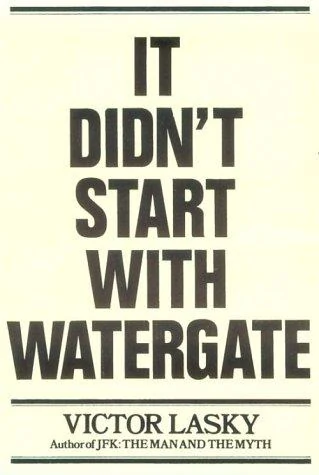
Read the decisions beneath the cover.
After a developed case, use a brief named-counterpart comparison to make its contribution to the argument explicit, while keeping unsupported equivalences visible.
Especially useful for: Writers revising a case-based argument whose individual accounts are clear but whose comparative purpose becomes hard to follow between cases.
How the decisions work together
The opening contends that Nixon received treatment unlike that of predecessors and opponents. Several developed accounts end with a short return to a named counterpart, through punishment, a conditional exception or contrasting outcomes. Repeating this local closing function links separate cases, while the final chapter shifts to a sympathetic farewell. The visible connections do not establish comparable conduct or justify the book’s disputed conclusions.
- Declare the comparison
The opening asks whether Nixon was treated differently from predecessors and opponents.
- Develop cases and return
Selected developed accounts close with a brief named-counterpart treatment or consequence comparison; the book does not use this form at every ending.
- End in a chosen perspective
The comparative indictment leads into a sympathetic farewell to Nixon, changing emotional focus without settling the disputed equivalences.
1 decision worth studying.
Start with the choice. Open its application and limits, or follow the source example.
Close a case with a named counterpart
Develop a case, then close its local account with a brief comparison that names a counterpart and contrasts their treatment or consequences; repeat that closing role across otherwise separate cases.
Explore the decision, application & limits
Why this choice matters
The local account and its comparative close do different work: one develops the case, while the short return states why it belongs in the argument. Repeating that closing role can connect cases of different lengths and subjects without restating the whole thesis each time.
Try the decision in your own work
- Mark the end of a developed case and identify the treatment or consequence that the local account supports comparing.
- Write a brief closing sentence, paragraph or question that names the counterpart and makes that specific comparison explicit. The counterpart may already have appeared earlier.
- Repeat that closing role where it serves the argument; do not force it onto every case or chapter. State relevant differences or uncertainty so the closing contrast does not imply equivalence it has not established.
Every chapter has a job.
Choose a section to see what it adds and which authoring decisions it makes visible.
Chapter 11
The Bobby Baker affair develops into a discussion of official investigations and alleged political protection. The chapter follows the conflict through Baker’s conviction, appeals, imprisonment and parole.
Its job in the book
Build the institutional background for the next surveillance comparison.
A decision to study
Follow the stated outcome as well as the allegations in an investigatory case.
Supplied text · lines 5516–6232. Summary and role are our analysis.
Link to this chapterThe book’s subject and overall argument
Lasky builds a polemical comparison around the contention that Watergate-era outrage obscured similar misconduct by earlier administrations and political opponents. He moves through surveillance, campaigns, official investigations and media conduct, repeatedly returning selected episodes to the question of how Nixon and others were treated.
That repetition gives the wide-ranging catalog a recognizable argument. It also exposes its central weakness: a shared label or different outcome does not establish equivalent conduct. The craft study retains the visible organizing decision while keeping the book’s disputed allegations, selective comparisons and sympathetic final portrait separate from verified conclusions.
The first chapter announces a comparison question; successive chapters gather cases from different periods and institutions, then repeatedly close a case by bringing Nixon or his associates back into view. The final chapters turn to the investigation and resignation, converting the comparison into a sympathetic farewell.
Sources & reading scope
Victor Lasky, It Didn't Start with Watergate, supplied text with The Dial Press, New York, 1977 title page.
Read the existing whole-source synthesis and all ten ordered segment summaries, section maps, qualifications and gap reports. Checked all 23 actual numbered chapter headings and their opening and closing passages, the complete narrative ending, and the Sources and Index boundaries. Read every retained example and its surrounding comparison, with the relevant chapter-source entries. Checked selected alternative candidates and author-position disclosures. Verified all ten consecutive source-input hashes and successful machine receipts. This is source-checked editorial review using the prior machine reading, not a new second full-book reading, independent model review or historical/legal fact audit. Private v2 revision rechecked the three retained passages and their source entries, two internal nonexamples, actual final prose and apparatus continuation under current source gates. It compared the proposal with all 46 canonical definitions at the recorded snapshot and reverified all ten complete source-input receipts. Earlier complete heading and ordered-report review is preserved; this bounded revision is not another full-book reading.
- The title page says The Dial Press, New York, 1977. The filename's E. P. Dutton designation is not used to establish the imprint. No separate copyright page or publisher-controlled comparison copy was inspected.
- The supplied prose has 23 numbered chapters and a substantive ending, followed by Sources for Chapters 1–23 and an index ending at printed page 438. This supports the supplied prose map without certifying every page or visual of a publisher edition. OCR corrupts names, hyphens, citations and several page numbers.
- Lasky’s argument favors Nixon and attacks what he portrays as unequal treatment of political misconduct. The study analyzes that argument’s construction; it does not endorse its allegations, explanations of motive, legal conclusions or historical equivalences.
- The book uses official records alongside memoirs, newspaper reports and opinion columns. A quotation or named source is not independent confirmation; several allegations remain disputed or expressly unestablished within the book.
- Comparisons often move between different conduct, actors, authority, periods, evidence and legal circumstances. The recurring question creates coherence, but does not establish comparable cases or explain differences in consequences.
- The book acknowledges Nixon’s errors and prints some denials and evidentiary qualifications while repeatedly minimizing the seriousness of his conduct. Those qualifications do not make its broad exculpatory judgments established findings.
- Lasky identifies himself as an earlier Kennedy critic, describes personal exchanges with Nixon, and discloses in a note that Laurence Rockefeller had financed an earlier book without Lasky knowing his patron’s identity at that time. These source-position disclosures matter when weighing the account.
- The closing congressional farewell relies on an unnamed participant’s notes as cited through a newspaper. No independent review of the recalled private scenes, primary transcripts or underlying legal records was conducted.
- Reader benefits are editorial interpretations, not measured effects. The study makes no longevity, market-outcome or independent author-family replication claim.
Editorial source check by Codex. No human or independent-model review is claimed. Chapter locations refer to the supplied transcription, not printed page numbers.