The End of the World Is Just the Beginning
Understand Zeihan’s account of how a breakdown in global connections could change the systems behind familiar goods and services, and which geographic differences he thinks would matter.
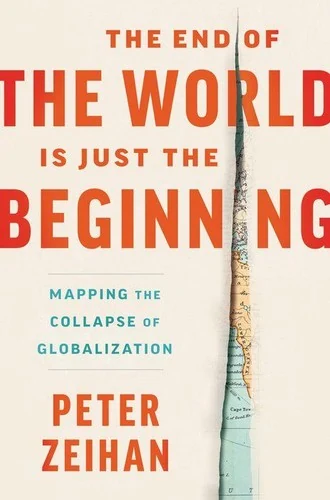
Read the decisions beneath the cover.
Begin with work an individual can attempt, expose what effort alone cannot supply, and show how surrounding systems make the result possible.
Especially useful for: Explanatory writers connecting everyday tasks to infrastructure, institutions or interdependent industries, especially when separate sector chapters need a shared payoff.
How the decisions work together
Zeihan builds geography and demography into a common frame, gives six sectors their own explanations, and recombines them around agriculture. The retained lesson shows how the limits of personal effort can make those interactions concrete; it does not endorse the book’s forecasts.
- Establish the enabling conditions
History, geography and population structure explain the conditions Zeihan says recent abundance requires.
- Follow separate sectors
Transport, finance, energy, materials and manufacturing each receive their own account of operations and exposure.
- Recombine around food
Agriculture brings the earlier inputs together and ties their continuity to the work of producing food.
- Turn toward recovery, then further questions
The epilogue sketches the recovery Zeihan expects, particularly in North America, before asking what the later world might become.
1 decision worth studying.
Start with the choice. Open its application and limits, or follow the source example.
Show what personal effort cannot supply
Show why an individual-level explanation or solution is incomplete, identify the surrounding incentives or interactions, and trace how they generate the observed outcome.
Explore the decision, application & limits
Why this choice matters
The reader first sees an activity one person can attempt, then learns why effort or expertise alone cannot sustain its outcome. Naming the missing functions makes the surrounding system part of the explanation; the agriculture example also reconnects subjects developed separately across the book.
Try the decision in your own work
- State the focal person’s task and show the limit of an individual solution; specify the function that extra effort cannot supply.
- Trace the relevant external inputs, timing and institutions through their actual interactions. Explain how those interactions enable or constrain the original task.
- Return to the outcome with those dependencies visible. Distinguish demonstrated constraints from assumptions about future disruption, and examine substitutes, buffers and different local arrangements.
Every chapter has a job.
Choose a section to see what it adds and which authoring decisions it makes visible.
Expanding the Diet, Shrinking the Diet
Corn, soy and rice are followed through their uses, growing conditions and trade relationships. Changing diets, animal feed and water dependence connect individual crops to the broader argument about access and specialization.
Its job in the book
Bring the food discussion from national exposure to staple-specific mechanisms.
A decision to study
Distinguish crops by the requirements that matter to the argument instead of treating calories as a single undifferentiated product.
Supplied text · lines 4396–4490. Summary and role are our analysis.
Link to this chapterThe book’s subject and overall argument
Peter Zeihan argues that the conditions behind recent global abundance—American-supported trade security and favorable population structures—are coming apart. He follows that forecast through transport, finance, energy, industrial materials, manufacturing and agriculture, asking which capacities different regions might retain or lose. The account is a forceful 2022 scenario whose factual claims and predictions are not independently validated by this study.
The book first builds a historical and demographic explanation, then gives its major economic sectors separate treatments before reconnecting them around food. Its strongest retained authoring lesson concerns the limit of individual effort: a household and a farm become ways to show why useful work depends on wider arrangements of equipment, inputs, infrastructure and finance. Everyday examples make those relationships inspectable without removing the need to question the author’s assumptions.
A foundational account of geography, technology and demography is followed by six sector studies. Agriculture comes last as a place where the preceding sectors interact, turning the book’s separate explanations back toward a basic human requirement.
Sources & reading scope
Peter Zeihan, The End of the World Is Just the Beginning; supplied HarperCollins first-edition digital text, June 2022, ISBN 978-0-06-323048-4, version 05062022. Prose extraction; charts and maps not available for review.
Codex compared all eight ordered whole-source AI segment reports and the completed synthesis with an editorial inspection of the supplied source. The source checks covered all main headings and section boundaries, selected opening, interior and closing contexts, and every retained example. The AI outputs informed the final coverage check and candidate evaluation; this is not a second whole-source reading, human review or independent-model craft review.
- Source-checked Codex editorial analysis; no human or independent-model craft review.
- The supplied prose includes seven parts, 45 main chapter entries, an introduction and an epilogue. It has not been collated against a publisher edition; publisher completeness is unverified.
- Maps, charts and other rendered graphics are unavailable in this extraction. This study concerns the supported prose and its organization, not the accuracy or visual design of those materials.
- The author’s 2022 historical explanations, technical claims and geopolitical, economic and food-supply projections are described as his claims. This study does not independently establish their accuracy, timing or inevitability.
- Proposed effects on readers are editorial interpretations, not measured comprehension, behavior or bestseller-longevity effects.
- Acknowledgments, index, biography and publisher material are distinct from the main chapter sequence. Asterisk notes occur after the copyright/publisher material; their LF order is extraction order, not a reconstruction of printed placement.
Editorial source check by Codex. No human or independent-model review is claimed. Chapter locations refer to the supplied transcription, not printed page numbers.