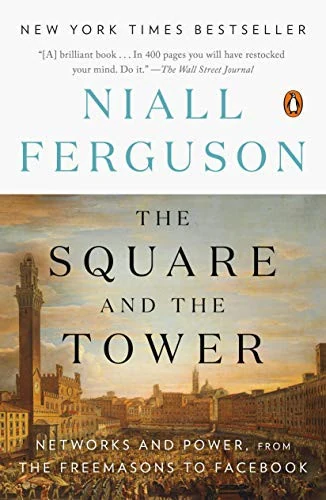
The Square and the Tower
Understand how relationships among people and institutions can change the history that formal offices and organizational charts appear to tell.
Read the decisions beneath the cover.
Give a conceptual introduction a visible payoff by returning to the opening case and specifying what its tools add.
Especially useful for: Explanatory histories and other nonfiction that teach a framework before a long sequence of cases.
How the decisions work together
The Illuminati appear before the network primer and return after it. The conclusion about their limited power is already present; the second pass earns its place by making the account of recruitment, organization and suppression more specific.
- Establish a case and a research problem
The preface and Illuminati opening distinguish formal authority, informal influence and exaggerated claims about secret power.
- Teach the tools and return
Conceptual chapters culminate in seven insights, followed by a deliberate reappraisal of the same order.
- Follow changing historical arrangements
The survey moves through network expansion, restored hierarchy, empire and concentrated twentieth-century power.
- Test the frame against contemporary cases
Diplomacy, computing, finance and political mobilization carry the same questions into the second networked era.
- Close with choices, place and methods
The conclusion asks about future order; Siena gives the title a setting, and the appendix discloses the limits of a central method.
1 decision worth studying.
Start with the choice. Open its application and limits, or follow the source example.
Return to the opening case after teaching the tools
Present a historical case, teach distinctions that can interpret its recognizable events, then return to those events and show the more specific explanation the distinctions enable.
Explore the decision, application & limits
Why this choice matters
The Illuminati return gives the introductory theory an immediate task before the much longer historical sequence begins. A writer can make the cost of learning terminology feel purposeful by showing exactly what it adds to a case the reader already knows; this effect is an editorial inference.
Try the decision in your own work
- Choose a case with identifiable events that the later explanation can revisit; establish what is already known on the first pass.
- Teach only distinctions that will do visible work in the return, then connect them to the original events and any newly introduced evidence.
- Make the second account more specific without pretending that repetition proves it; retain qualifications and distinguish added facts from a changed interpretation.
Every chapter has a job.
Choose a section to see what it adds and which authoring decisions it makes visible.
Henry Kissinger’s Network of Power
Kissinger’s contacts across government, diplomacy and media offer a case of power exceeding a formal office. A memoir-based network analysis develops that claim while acknowledging that remembered importance is not a direct measure of interaction.
Its job in the book
Provide the major original research case behind the book’s premise.
A decision to study
Expose the proxy and its limits when translating documentary traces into an analytical model.
Supplied text · lines 2116–2213. Summary and role are our analysis.
Link to this chapterThe book’s subject and overall argument
Ferguson interprets a long historical sequence through the relationship between formal hierarchies and informal networks. A conceptual introduction supplies a vocabulary for connection, brokerage and diffusion before short historical chapters follow changing arrangements of power from the Renaissance through modern digital platforms.
The architecture is particularly useful to a writer who must make a framework earn its place in a history. The Illuminati appear before the network primer and return after it: recognizable events acquire more specific explanations, while the original claim of limited influence is retained. The study admits that observable return as a craft lesson without certifying the wider historical thesis.
The opening case is followed by conceptual equipment and a return to that case; nine parts then alternate network disruption, hierarchical restoration and their changing coexistence, ending with the contemporary stakes and a historical setting for the title.
Sources & reading scope
Niall Ferguson, The Square and the Tower, supplied Penguin Press text (copyright 2017; e-book ISBN 9780735222922).
Read the complete whole-source AI synthesis and the summaries, section maps, qualifications and gaps of all ten ordered segments. Checked all sixty main chapter headings and bounded opening, middle and ending contexts; directly inspected the complete opening Illuminati case, Chapter 9 toolkit and Chapter 10 return, with their qualifications. Checked preface and appendix context, corrected the draft’s part boundaries and insight count, and classified the detached notes separately from the narrative. A failed segment boundary quotation and two anchors away from input edges remain disclosed. This is a source-checked editorial pass, not a second complete reading or an independent craft review.
- The supplied Penguin Press text gives copyright 2017 and hardcover/e-book ISBNs. The filename’s 2018 date is not independently established as this extraction’s edition date; no publisher-controlled collation was performed.
- All sixty numbered chapters in nine parts, the preface, afterword and methodological appendix are mapped. Prose and captions survive, but diagrams and plates are absent; no lesson about their visual execution is admitted.
- Numbered references, bibliography, index, publisher material and detached asterisk notes remain part of the supplied file. The file’s final line is not the end of the narrative; detached notes are not additional chapters.
- The historical interpretations, statistical claims and forecasts are Ferguson’s arguments, not independently established findings of this study. Network measures and a compelling comparison do not by themselves prove a historical cause.
- Reader effects and writer usefulness are editorial inferences. This pass does not establish effects on sales, longevity or actual reader comprehension.
- This is a source-checked editorial pass using AI reading notes, not a second complete reading, human review or independent craft review.
- The ten segment receipts record complete consecutive source submission, not comprehension. Segment 4’s final quotation was not recovered; direct inspection locates a differently worded question at the boundary. Segment 1’s first anchor follows front matter, and segment 8’s last anchor occurs in the appendix before the submitted references end. Original receipts remain unchanged.
Editorial source check by Codex. No human or independent-model review is claimed. Chapter locations refer to the supplied transcription, not printed page numbers.