Women Who Run with the Wolves
The book offers readers a symbolic vocabulary and a set of stories through which to reflect on instinctive, creative and relational life. The study examines how that invitation is constructed, without endorsing its clinical or universal claims.
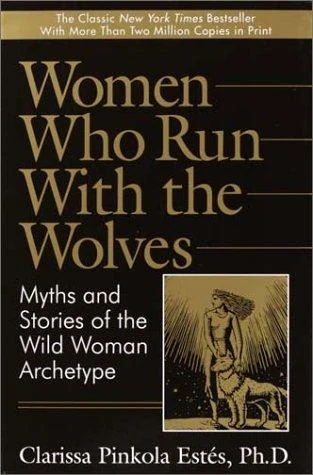
Read the decisions beneath the cover.
Give readers a recognizable story, show precisely how your interpretation rereads it, and distinguish the material you inherited from the version you made.
Especially useful for: Writers of interpretive nonfiction who work with traditional stories, adapted narratives or symbolic readings and need to make their own mediation visible.
How the decisions work together
In the inspected Bulgarian translation, a sustained tale often precedes a more detailed return to its events and objects. Vasilisa becomes a sequence of psychic tasks and the Red Shoes carriage becomes a named trap; these are Estés’s interpretations. Elsewhere she names a received tale or core and states her own development of it. Together, the decisions help readers follow both how a version was made and how it is being read, while leaving authenticity and psychological validity as separate questions.
- Present the recognizable material
Give the tale enough continuity for its events and objects to be remembered during the commentary.
- Make the rereading explicit
State a lens and return to particular events through interpretive sections.
- Expose the mediation
Identify received cores, authorial expansions and the limits of the resulting reading.
2 decisions worth studying.
Start with the choice. Open its application and limits, or follow the source example.
Reread a complete tale through an explicit lens
After telling a complete tale, declare an interpretive lens and revisit identifiable events and objects from that tale under the new lens.
Explore the decision, application & limits
Why this choice matters
The same material gets two visible jobs: first it establishes what happens, then it gives the interpretation specific details to account for. Named task or trap sections make the author’s mapping inspectable, although they do not make it the only possible reading.
Try the decision in your own work
- Give enough of the narrative for its events and objects to remain recognizable during the later interpretation.
- State the lens and its status as an interpretation, including any broad frame already introduced before the tale.
- Revisit concrete details under that lens and keep the story’s events separate from the claims the commentary assigns to them.
Name the received story and your part in reshaping it
When introducing a retelling, identify the received core or version and its source, then state how the present author has developed or changed it.
Explore the decision, application & limits
Why this choice matters
A reader can distinguish inherited material from the version this author has made. This makes a specific act of mediation visible before the retelling begins to carry an interpretation; a source name alone would not disclose that transformation.
Try the decision in your own work
- Identify the particular source and the scope of what was received, such as a short tale, a core motif or a version.
- State the author’s own expansion, naming or other transformation at the point where the retelling is introduced.
- Keep that disclosure separate from claims about authenticity, age, representativeness or the truth of a later interpretation.
Every chapter has a job.
Choose a section to see what it adds and which authoring decisions it makes visible.
12. Anger and forgiveness — second source 12 (descriptive)
The Moon Bear story is interpreted as a route through anger, followed by Dry Trees as a discussion of righteous anger. Life maps and four named aspects of forgiveness extend the chapter’s applications without establishing their clinical effectiveness.
Its job in the book
Combines a central tale, a qualifying counter-tale and practical reflection.
A decision to study
Use a second story to complicate the first story’s apparent lesson, rather than pretending one response fits every case.
Supplied text · lines 12096–13046. Summary and role are our analysis.
Link to this chapterThe book’s subject and overall argument
Estés combines retold tales, personal accounts and Jungian interpretation around her Wild Woman archetype. Stories including Bluebeard, Vasilisa, Skeleton Woman, The Red Shoes and The Handless Maiden become material for discussions of intuition, belonging, creative life, relationships and renewal. These are the author’s symbolic readings and psychological claims, not conclusions independently established by the tales.
The inspected Bulgarian text often tells a sustained story and then revisits its events through an explicit interpretive scheme. It also identifies received versions and, in several places, the author’s own development of them. A local foreword, an author-method afterword, an appendix and extensive notes surround the main sequence; this study distinguishes that translated edition’s visible structure from unverified claims about the English original.
Recognizable tales give the commentary stable events and images to revisit. Explicit interpretive mappings then turn those same details into tasks, traps and stages, while attribution and adaptation notices identify some of the choices through which the tales reached this version.
Sources & reading scope
Clarissa Pinkola Estés, Women Who Run with the Wolves, inspected Bulgarian translation credited to Krum Bachvarov (2001), Bard (2010), ISBN 954-585-212-7; 1-based LF anchors in the supplied extraction.
Read the complete whole-source AI synthesis and the ordered summaries and section maps of all ten submitted segments; checked the supplied contents against every main body heading and inspected section openings and endings. Directly read the Vasilisa and Red Shoes tales and selected subsequent interpretations, the admitted provenance passages and their surrounding contexts, and relevant author-method and qualification passages. English descriptions are this editorial pass’s paraphrases of the Bulgarian source. This is a source-checked editorial pass, not a second complete reading, specialist translation review or independent-model review.
- The inspected source is a Bulgarian translation. Its header credits Krum Bachvarov for the 2001 translation and Bard for the 2010 edition, with original copyrights 1992 and 1995. No comparison with an English original or publisher-controlled copy was completed; English section titles here are descriptive labels, not verified original headings.
- The supplied contents and body both label the sexuality chapter and the following anger chapter 12, and have no chapter labeled 11. Both distinct blocks are mapped separately. Focus, The Little Match Girl and Three Gold Hairs remain inside source Chapter 10. This covers all 16 visible main chapter blocks without certifying completeness against another edition.
- Contents page references are inconsistent, and the endnotes have numbering and heading anomalies. The map uses LF positions in the actual supplied body, not contents page numbers. The extent of any lost or altered source material is unverified.
- Tales, clinical anecdotes, etymologies and cross-cultural parallels are analyzed as material selected and interpreted by Estés. They do not independently establish a universal female psychology, therapeutic efficacy, historical origin or equivalence among traditions.
- Named oral sources and statements about permission or adaptation are the author’s account. They were not independently verified, and the disclosed expansions do not specify every changed detail.
- Reader effects are editorial inferences, not measured responses or demonstrated causes of sales or longevity. No claim about the original English prose style is made.
Editorial source check by Codex. No human or independent-model review is claimed. Chapter locations refer to the supplied transcription, not printed page numbers.