A Brief History of Time
Follow the questions and conceptual changes that lead from familiar pictures of space and time to black holes, the early universe and the search for a unified account, without presenting that search as already finished.
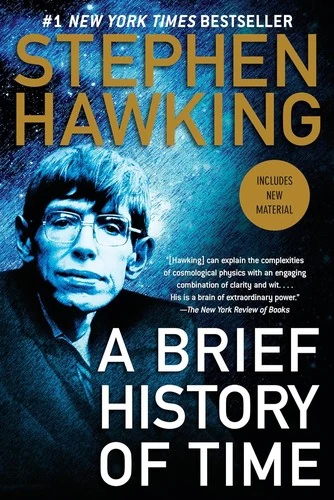
Read the decisions beneath the cover.
A book can remain coherent while its explanations change if it teaches the reader how to judge those changes and returns to that standard.
Especially useful for: Writers guiding general readers through difficult, provisional or competing explanations.
How the decisions work together
Hawking first defines what an account must explain, then builds the conceptual tools whose limits generate the next questions. The strongest transferable decisions are making the evaluative criteria reusable and showing exactly what a consequential correction changes.
- Set the question and the standard
World pictures lead to criteria for theories and the problem of joining relativity with quantum mechanics.
- Build the partial accounts
Space, time, uncertainty, particles and forces provide the tools for the harder cases.
- Test the meeting points
Black holes and the origin of the universe force the tools into contact.
- Revisit implications and limits
Time’s direction, time travel and unification return to the initial questions without claiming all are settled.
2 decisions worth studying.
Start with the choice. Open its application and limits, or follow the source example.
Give the reader a standard before judging competing accounts
State explicit criteria for accepting or revising an account early, then invoke those same criteria when assessing later rival accounts and the author’s preferred explanation.
Explore the decision, application & limits
Why this choice matters
The repeated standard gives a long sequence of disagreements a common question: what observation or prediction warrants this judgment? That can make revisions easier to follow without requiring the reader to equate scientific merit with permanent correctness.
Try the decision in your own work
- Specify the criteria and the sort of evidence that would count against an account before the hardest dispute.
- Apply the same criteria to a rival account and your own preferred explanation; separate being testable from being established.
- Return to the criteria at later decisions and disclose where the reader cannot inspect the underlying evidence.
Let a failed prediction improve the explanation
Teach a plausible explanation, expose the observation or reasoning it cannot accommodate, and return to its original question with a revised account.
Explore the decision, application & limits
Why this choice matters
Hawking identifies both an attractive symmetry and the analogy that helped mislead him. The correction changes the relation among the arrows of time and gives the following explanation a necessary question, instead of leaving the admission as a personal aside.
Try the decision in your own work
- State the earlier inference and why it seemed plausible.
- Identify the specific correction, credit the people or evidence responsible, and say which part of the account changes.
- Revisit the original question using the revision; distinguish a report of technical work from a demonstration the reader can reproduce.
Every chapter has a job.
Choose a section to see what it adds and which authoring decisions it makes visible.
Our Picture of the Universe
Successive world pictures lead from the shape of Earth to expansion and the question of a beginning. Hawking defines what he means by a scientific theory, explains its provisional status and identifies the tension between relativity and quantum mechanics as the book’s main problem.
Its job in the book
Establish the questions, standards and destination.
A decision to study
Give readers a basis for judging later disagreements before those disagreements become technically demanding.
Supplied text · lines 159–230. Summary and role are our analysis.
Link to this chapterThe book’s subject and overall argument
Stephen Hawking organizes a tour of cosmology around the difficulty of combining two powerful but incomplete accounts: general relativity and quantum mechanics. The reader first encounters changing pictures of the universe, then the ideas about motion, light, matter and probability needed to follow the later questions. Black holes provide a meeting place for these ideas before the discussion returns to the origin and possible fate of the universe.
The later chapters examine the direction of time, time travel and the possibility of a unified theory. Historical examples, everyday analogies and Hawking’s own accounts of research make changes of explanation visible. The conclusion returns to the opening question of what makes a picture of the universe adequate, while leaving the larger question of why the universe exists open. The study describes the argument in this updated source; its scientific forecasts and claims are not presented as a current account of cosmology.
Teach the criteria and partial theories first, bring them into contact at black holes and the universe’s origin, then test what the combined picture can and cannot explain. Recurring qualifications make revision part of the journey.
Sources & reading scope
Stephen Hawking, A Brief History of Time; supplied updated local ebook text; copyright 1988 and 1996, publishing history lists 1998 Bantam editions; eISBN 9780553896923. Includes the added chapter on wormholes and time travel.
The completed whole-source AI synthesis supplied candidate observations and the broad argument map. This Codex editorial pass checked original source headings, section boundaries, openings and selected argumentative contexts; inspected every retained example; checked the existing pattern dictionary and base examples; and rewrote or rejected nominations. It is a source-checked editorial pass, not a new independently adjudicated whole-book reading.
- No human or independent-model review has been completed.
- The local extraction has not been compared page by page with a publisher edition; graphical layout and completeness are not independently certified.
- The book’s empirical and historical claims are described as claims made by the author, not independently verified findings of this study.
- Proposed effects on readers are editorial interpretations, not measured comprehension, behavior or longevity effects.
- This is an updated text, not the unchanged 1988 first edition. The source’s publishing-history dates and later author biography do not certify the date represented by its filename.
- All twelve main chapters and the Foreword are mapped. Three short biographical appendices, Glossary, Acknowledgments and About the Author are present after the Conclusion and are treated as backmatter, not missing main chapters.
- The local extraction contains figure references but does not establish the integrity of every illustration. The admitted examples rely on prose. No present-day scientific accuracy assessment was performed.
Editorial source check by Codex. No human or independent-model review is claimed. Chapter locations refer to the supplied transcription, not printed page numbers.