Astrophysics for People in a Hurry
Acquire a brief foundation in the concepts and questions of astrophysics that can support further reading and conversation, without attempting a comprehensive textbook treatment.
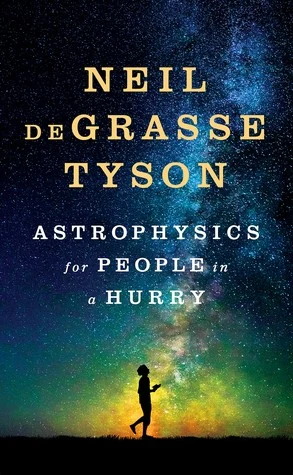
Read the decisions beneath the cover.
Keep a compressed explanation navigable by marking the stages of a process and exposing the gap between an observation and a conclusion.
Especially useful for: Writers giving a short, general-audience introduction to technical material with large changes of scale or indirect evidence.
How the decisions work together
A brief chronology supplies the foundation for compact topical chapters. Time checkpoints keep the opening process located, and the imagined investigation of Earth makes the later observational methods concrete without hiding what they cannot establish.
- Promise a usable short introduction
The preface specifies basic fluency for readers with limited time.
- Set the temporal and conceptual foundation
Cosmic history leads into laws, background radiation and unresolved components.
- Tour the tools and objects
Elements, shapes, kinds of light and interplanetary space expand the reader’s inventory.
- Turn the view toward Earth
Indirect detection methods lead into the author’s interpretation of a cosmic perspective.
2 decisions worth studying.
Start with the choice. Open its application and limits, or follow the source example.
Give a compressed chronology explicit time checkpoints
Interrupt a dense chronological explanation with brief, visibly separate statements of elapsed time, then tie each interval to the conditions or processes that have changed.
Explore the decision, application & limits
Why this choice matters
The first chapter covers enormous differences of scale while explaining unfamiliar processes. The recurring time statements let the reader locate a stage without extracting chronology from every technical paragraph; their juxtaposition also shows how much change the account places inside a tiny interval.
Try the decision in your own work
- Identify the transitions where losing track of elapsed time would confuse the explanation.
- Place short time checkpoints near those transitions, and explain what the new conditions permit or prevent.
- Change the level of temporal detail deliberately as the story moves to broader intervals; keep estimates and uncertain reconstructions qualified.
Let the reader reconstruct the inference
Present concrete inputs and the intermediate reasoning connecting them to a conclusion, including an alternative interpretation or a limit on what the observation can establish.
Explore the decision, application & limits
Why this choice matters
Using Earth as a target lets Tyson separate the familiar object from the much thinner signal available at a distance. The reader can follow why a dip in light indicates a planet, or why a radio signal invites more than one explanation, instead of receiving a list of tools and discoveries.
Try the decision in your own work
- Specify what the observer can actually measure before naming what the measurement is taken to show.
- Work the intermediate relation, including a quantity or geometric constraint when it does explanatory work.
- State what remains unobserved and consider another cause that could produce the same signal.
Every chapter has a job.
Choose a section to see what it adds and which authoring decisions it makes visible.
Invisible Light
The chapter expands light beyond what human eyes detect and follows the instruments that make other bands available to astronomy. A literary opening returns at the close after the inventory of observable phenomena has grown.
Its job in the book
Show how instruments extend the evidence available to a sense-limited observer.
A decision to study
Connect an instrument’s design to the kind of information it can reveal.
Supplied text · lines 813–919. Summary and role are our analysis.
Link to this chapterThe book’s subject and overall argument
Neil deGrasse Tyson offers a short route through the concepts and discoveries he considers foundational to a general reader’s understanding of astrophysics. An opening account of cosmic history leads into physical laws, background radiation, the contents of apparently empty space, and the problems named dark matter and dark energy. Later chapters shift among elements, shapes, kinds of light and the solar neighborhood, using familiar objects and questions to keep the scale changes accessible.
The penultimate chapter turns Earth into the object of an imagined distant investigation, using that reversed viewpoint to explain what observations can reveal and what they leave uncertain. The final chapter moves from scientific exposition to Tyson’s reflections on a cosmic perspective and its human significance. The source identifies the chapters as adaptations of magazine essays. This study treats its scientific quantities, discovery counts and open questions as statements in the inspected 2017 edition, rather than a current scientific reference.
Begin with a compressed temporal overview, develop a set of short conceptual tours, then turn the observational tools back toward Earth before shifting to human significance. Within the compression, explicit time markers and inspectable inferences help readers locate what an explanation is doing.
Sources & reading scope
Neil deGrasse Tyson, Astrophysics for People in a Hurry; supplied W. W. Norton First Edition ebook text, copyright 2017; e-book ISBN 9780393609400.
The completed whole-source AI synthesis supplied candidate observations and the broad argument map. This Codex editorial pass checked original source headings, section boundaries, openings and selected argumentative contexts; inspected every retained example; checked the existing pattern dictionary and base examples; and rewrote or rejected nominations. It is a source-checked editorial pass, not a new independently adjudicated whole-book reading.
- No human or independent-model review has been completed.
- The local extraction has not been compared page by page with a publisher edition; graphical layout and completeness are not independently certified.
- The book’s empirical and historical claims are described as claims made by the author, not independently verified findings of this study.
- Proposed effects on readers are editorial interpretations, not measured comprehension, behavior or longevity effects.
- All twelve main chapters and the Preface are present and mapped. The Acknowledgments, Index, author biography and copyright material follow the final chapter and are not additional main chapters.
- The copyright page attributes every chapter to adaptations of Universe essays in Natural History magazine, with source dates between 1997 and 2007. This record analyzes the supplied 2017 book text, not those earlier article versions.
- Scientific quantities, technology descriptions, discovery totals and predictions remain tied to this edition; they have not been checked against current research. The imagined observers in Chapter 11 are a teaching device, not a report of extraterrestrial observation.
- The local extraction preserves the standalone elapsed-time sentences used in the first chapter. This review does not certify their exact weight, spacing or typographic design in print.
Editorial source check by Codex. No human or independent-model review is claimed. Chapter locations refer to the supplied transcription, not printed page numbers.