At Dawn We Slept
Explain how the attack became possible by following the Japanese and American sides, then examine how responsibility was investigated and argued afterward.
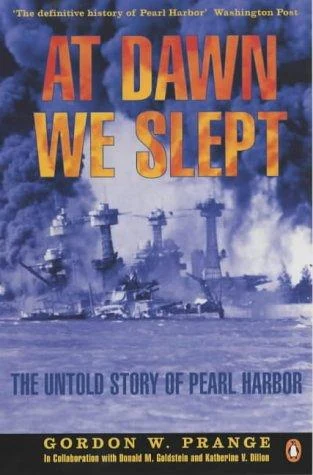
Read the decisions beneath the cover.
Help readers connect a dispersed history by aligning independent decisions in time, then show which disagreements can be weighed and which the record leaves open.
Especially useful for: Writers of institutional histories, investigations and event narratives with many participants, uneven information and disputed judgments.
How the decisions work together
The promise to explain Pearl Harbor from both sides is carried by separate Japanese and American timelines that repeatedly meet at a date, a warning or a technical problem. The attack brings those preparations into contact, but the book continues into competing investigations rather than treating the dramatic event as the end of understanding. Close comparisons of documents, recollections and judgments support its inquiry while revealing selected limits of what the authors can conclude.
- Establish the separate decisions
Prelude follows planning, warnings and disagreement until the attack plan gains acceptance.
- Bring the timelines together
Action connects preparation and perception through explicit dates and shared questions, ending with the choice to withdraw.
- Examine the resulting accounts
Aftermath follows inquiries and competing judgments; later editorial sections remain visibly distinct from the original narrative.
3 decisions worth studying.
Start with the choice. Open its application and limits, or follow the source example.
Synchronize separate timelines around the same question
Establish separate chains of action, explicitly align their dates or intervals, and compare what different participants are doing or understanding about the same consequential question.
Explore the decision, application & limits
Why this choice matters
A reader can see the gap between preparation and perception without receiving each side as a separate story to reconstruct afterward. Repeated alignment gives a long distributed history a usable structure; the comparisons remain selected interpretations.
Try the decision in your own work
- Choose a consequential question that both timelines actually address, such as a technical possibility or a warning.
- Establish each sequence on its own terms, then provide an explicit date or qualified interval when you bring them together.
- Compare what each participant knew and did; mark approximate timing and avoid implying that coincidence proves contact or cause.
Show what disagreeing sources permit you to say
Identify conflicting source accounts, explain the basis for choosing among them or retaining uncertainty, and make the narrative’s degree of precision agree with that decision.
Explore the decision, application & limits
Why this choice matters
A claim about an ignored warning depends on what the warning actually said and whether a remembered conversation occurred. Showing a weighed translation dispute beside an unresolved recollection conflict makes those different evidentiary positions visible.
Try the decision in your own work
- Identify the disputed detail and why it matters before choosing a version.
- Give the actual basis for preferring one account, including its dependence on later testimony.
- Where the record does not resolve the conflict, preserve that uncertainty in the narrative instead of completing the scene by inference.
Put incompatible assessments close enough to compare
Arrange short assessments of the same person or proposal in a close sequence so that their specific incompatibilities remain visible, while identifying the setting and limits of the selection.
Explore the decision, application & limits
Why this choice matters
The plan and the withdrawal can otherwise look like decisions whose merit was obvious. A compact sequence of named objections and defenses shows the different priorities involved before the narrator or commander supplies a verdict.
Try the decision in your own work
- Hold one identifiable proposal or decision constant across the sequence.
- Choose assessments with different substantive grounds and identify who supplies each one.
- Distinguish a decision imposed by authority from a disagreement resolved by evidence, and label any later authorial verdict.
Every chapter has a job.
Choose a section to see what it adds and which authoring decisions it makes visible.
“DERELICTION OF DUTY”
The Roberts Commission's people, procedures and verdict receive sustained examination. The authors criticize the judgment while limiting evaluation to evidence then available to the commissioners.
Its job in the book
Establish the first inquiry and its evidentiary limits.
A decision to study
Evaluate a finding in relation to the record its investigators could examine.
Supplied text · lines 8314–8469. Summary and role are our analysis.
Link to this chapterThe book’s subject and overall argument
The collaborative history makes Pearl Harbor a problem of connected actions and disconnected understanding. It follows Japanese planning, American preparation and diplomacy on separate timelines, then repeatedly places them beside one another so the reader can see differences the participants could not.
Its structure continues beyond the attack into investigations and competing judgments about responsibility. Documents, interviews and explicit disagreements let the book argue strongly while occasionally showing where its record cannot support a definitive scene or conclusion; those visible limits are part of how this study evaluates the craft.
The book turns separate timelines into a shared inquiry: Prelude secures acceptance of the plan, Action carries it through the withdrawal decision, and Aftermath tests interpretations of what happened. Repeated temporal comparisons and visible disagreements keep the breadth connected to the central question of preparation and surprise.
Sources & reading scope
Gordon W. Prange, in collaboration with Donald M. Goldstein and Katherine V. Dillon, At Dawn We Slept, supplied Penguin text with 1991 afterword.
Read the existing whole-source synthesis and all 24 ordered segment summaries, section maps, qualifications and gap reports. Checked all 81 numbered body headings against the contents, their source ranges, opening orientation and closing text, distinguishing photograph-caption inserts from narrative endings; checked the main ending and the separate afterword and source-apparatus boundaries. Read the complete retained example passages and their surrounding arguments, plus title-page, imprint and editorial-role disclosures. Verified all 24 consecutive segment source-input hashes and successful receipts. This is a source-checked editorial review using the prior machine reading, not a new second full-book reading, an independent model review or a historical fact audit.
- The supplied Penguin text identifies the 1981 original and the edition with a 1991 afterword, ISBN 9781101664216. The filename's 2016 date is not used to establish the edition. No publisher-controlled comparison copy was inspected.
- Prange died before publication. Goldstein and Dillon identify themselves as editors who condensed a manuscript of more than 3,500 pages; narrative craft here belongs to the credited collaborative book, not demonstrably to Prange alone. Revisionists Revisited is their signed summary of omitted manuscript chapters.
- All 81 main chapter headings and substantive endings are present, followed by the afterword and extensive apparatus. This supports the supplied prose map, not certification of every page or visual in a published edition. Photographs and charts were not visually inspected; surviving captions are not treated as images.
- The account reconstructs dialogue, motives and scenes from interviews and documents. The editors disclose some combined interview notes and a selected bibliography; several underlying materials are described as private or unpublished. Checking an exact quotation in this text does not independently verify the historical statement.
- The book's causal judgments, assessments of commanders, imagined alternatives and rebuttals of revisionist history are its interpretations. Its 1991 afterword and 1981-bounded appendix do not establish the current state of Pearl Harbor scholarship.
- Some descriptions use dated stereotypes, physiognomic judgments or emphatic narrator verdicts. Those devices are not endorsed as evidence about character. The Preface's warning against oversimplification also limits the later root-disbelief formulation.
- Chronological alignment is selected by the authors; approximate coincidences do not establish communication or causation. Source disagreements and competing judgments are visible in the retained examples, not exhaustively audited throughout the book.
- Reader benefits are editorial interpretations, not measured effects. The study makes no longevity, market-outcome or independent author-family replication claim.
Editorial source check by Codex. No human or independent-model review is claimed. Chapter locations refer to the supplied transcription, not printed page numbers.