Games People Play
Recognize and describe recurring interpersonal exchanges, then understand the author’s account of what it might mean to move beyond them.
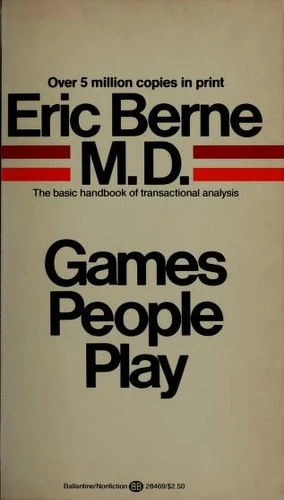
Read the decisions beneath the cover.
Teach the reader how to inspect an entry before presenting a large catalog, and let selected dialogues show how an interpretation changes a response.
Especially useful for: Writers building a field guide, taxonomy or explanation of recurring situations that readers may revisit out of order.
How the decisions work together
The opening vocabulary separates several kinds of social exchange. A developed case then teaches an analytical entry format that the central thesaurus can reuse in shorter forms. Selected conversations make the difference between apparent purpose and attributed function visible, while the final part asks what lies beyond the catalog. The transferable lesson concerns organization and explanatory sequence; Berne’s clinical and cultural judgments remain claims within the historical text.
- Install distinctions
Differentiate the vocabulary and neighboring categories before defining games.
- Teach, then reuse a format
Develop one analysis and carry recognizable fields into a catalog with explicitly varying depth.
- Describe an alternative
Move from the catalog to the author’s account of autonomy and game-free interaction.
2 decisions worth studying.
Start with the choice. Open its application and limits, or follow the source example.
Teach an entry format before asking readers to browse it
Work through the fields of a reusable reference entry in one developed case, then reuse a recognizable subset of those fields across the catalog.
Explore the decision, application & limits
Why this choice matters
Readers can learn what each field is for while following a concrete case. Later compressed entries can then expose comparable questions without requiring every entry to reteach the whole framework; that is an inferred use of the format, not a measured reading benefit.
Try the decision in your own work
- Choose the decisions or distinctions every substantial entry must make visible, and test those fields on one developed case.
- Teach what each field contributes before abbreviating it in later entries.
- Explain which fields may be omitted or shortened and why; leave genuine gaps visible rather than filling the template with unsupported content.
Change the diagnostic question
Contrast a literal or habitual reading of an utterance/action with a different question that reveals its function, then demonstrate how the response changes.
Explore the decision, application & limits
Why this choice matters
Berne first lets an advice exchange unfold, then asks what the sequence accomplishes when every suggestion is rejected. The changed question gives his proposed response a reason; the reader can inspect how the interpretation leads to a different move.
Try the decision in your own work
- Show enough of the exchange for its apparent purpose and recurring outcome to be visible.
- Name the evidence for a different interpretation and distinguish it from a confident guess about another person’s motives.
- Demonstrate how the alternative reading changes the response, including where the proposed response is unnecessary or inappropriate.
Every chapter has a job.
Choose a section to see what it adds and which authoring decisions it makes visible.
Consulting Room Games
The classification turns toward therapists, professionally trained patients and other clients. Help-giving and psychiatric language become possible subjects of the analysis rather than remaining outside its scope.
Its job in the book
Apply the framework to the profession that supplies the framework.
A decision to study
A diagnostic book can test its consistency by including the observer’s own professional roles.
Supplied text · lines 2119–2370. Summary and role are our analysis.
Link to this chapterThe book’s subject and overall argument
Eric Berne presents recurring social exchanges as patterns that can be described through transactions, roles and payoffs. The book first teaches the vocabulary of Parent, Adult and Child and distinguishes games from procedures, rituals, pastimes and candid operations. A developed marriage case then shows how an analysis can be organized into recurring fields.
The central thesaurus groups named games by settings such as marriage, parties and the consulting room. Its entries vary in depth, sometimes giving compact analysis cards after longer explanations. The final part asks what life beyond these patterns might involve and defines autonomy through awareness, spontaneity and intimacy. These are the author’s historical clinical formulations; the study examines how the book teaches and organizes them.
A vocabulary and worked analytical format prepare a browsable catalog; a final interpretive section then asks what the catalog means and what an alternative might look like.
Sources & reading scope
Eric Berne, Games People Play, inspected Penguin source, copyright 1964; LF line anchors in local extraction.
Used the complete existing whole-source AI synthesis as nominations; directly checked the original supplied source at every admitted example, its surrounding explanation, all main chapter headings and selected openings/endings. Rewrote or rejected overbroad nominations. This is a source-checked editorial pass, not a new page-by-page reading or independent-model review.
- The local extraction has not been compared with a publisher-controlled edition for completeness, diagrams or layout.
- Reader effects are editorial interpretations, not measured outcomes or explanations of sales or longevity.
- Clinical, biological and cultural propositions are Berne’s historical claims; the craft study does not validate them or offer the book’s interventions as clinical advice.
- The source’s gender assumptions and stigmatizing clinical labels affect its examples. Describing the organization does not endorse those judgments.
- The inspected header identifies Penguin; the filename’s Ballantine 1996 label is not used as edition evidence.
Editorial source check by Codex. No human or independent-model review is claimed. Chapter locations refer to the supplied transcription, not printed page numbers.