The Millionaire Next Door
Recognize the habits and trade-offs the authors associate with accumulating wealth, then examine the reader’s own household through those distinctions.
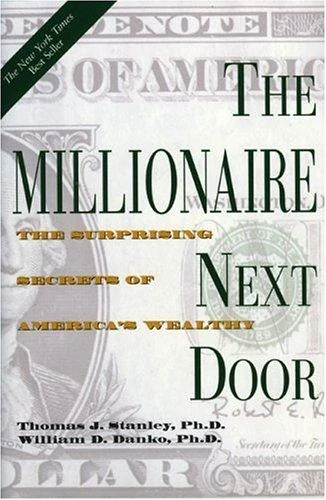
Read the decisions beneath the cover.
Make the opening distinction do repeated work: turn it into a test, use it to compare cases, and show the decisions it brings into view.
Especially useful for: Writers developing a practical argument around a misunderstood measure of success or a distinction readers can apply repeatedly.
How the decisions work together
The promise is to recognize wealth beyond income and visible consumption. The book first installs an alternative yardstick, then carries it through household spending, time, cars, family support, and work. Recurring classifications and the paired physicians keep the original distinction active as the questions change. Selected cases become concrete procedures, including a purchasing request readers can inspect. The resulting design connects a revised way of seeing with a sequence of decisions, while the benchmark and reported cases retain their limits.
- Change the yardstick
Distinguish accumulated wealth from income and display, then explain the book's benchmark and categories.
- Carry it through cases
Use the distinction across successive household questions, including repeated comparisons of the same two physicians.
- Expose the decisions
Show practical artifacts and extend the accumulation-versus-display question into family and occupational choices.
3 decisions worth studying.
Start with the choice. Open its application and limits, or follow the source example.
Turn an abstract distinction into a recurring test
After distinguishing income from wealth, supply a simple benchmark and named categories, then apply them to the book’s cases.
Explore the decision, application & limits
Why this choice matters
The reader can evaluate later portraits using a previously learned operation. The labels compress a repeated comparison, although ease of use does not establish measurement quality.
Try the decision in your own work
- Name exactly what the comparison measures and what it leaves out.
- Work a numerical example before assigning the reader or a character to a category.
- Reuse the same measure consistently and identify populations for which it is only approximate.
Carry the same contrasting pair through successive decisions
Introduce two broadly comparable people, then revisit both under the same sequence of practical questions.
Explore the decision, application & limits
Why this choice matters
Stable protagonists reduce the work of learning each example and make differences easier to notice. The continuity lets a chapter accumulate detail instead of repeatedly restarting.
Try the decision in your own work
- State which background features are similar and which remain unknown.
- Use the same questions and domains for both people.
- Return to the comparison after each new domain while distinguishing illustration from causal proof.
Show the document that performs the advice
Move from a general recommendation to an example of the actual request, script, or form used to execute it.
Explore the decision, application & limits
Why this choice matters
A reader can see the hidden decisions inside the action: recipients, specifications, comparison criteria, and response format. The advice becomes inspectable rather than remaining an attractive abstraction.
Try the decision in your own work
- Establish the problem that the artifact solves before showing it.
- Include the fields that let someone adapt the procedure to another situation.
- Explain which parts are enduring decisions and which depend on a particular technology or market.
Every chapter has a job.
Choose a section to see what it adds and which authoring decisions it makes visible.
Find Your Niche
The audience shifts toward people selling products and services to affluent households and their heirs. Historical forecasts of wealth transfers lead into categories of professional and commercial opportunity.
Its job in the book
Reuse the population described earlier as a market that another reader could serve.
A decision to study
Signal the audience shift explicitly and organize a broad opportunity into identifiable services.
Supplied text · lines 4568–4885. Summary and role are our analysis.
Link to this chapterThe book’s subject and overall argument
Stanley and Danko organize a book about wealth around a correction to how wealth is recognized. Income, professional standing, and expensive possessions can conceal weak accumulation; modest appearances can conceal substantial assets. Their surveys and interviews become household portraits, spending comparisons, named categories, and practical questions that ask readers to examine the gap between earnings and retained wealth.
The book first changes the reader’s yardstick, then follows that yardstick through budgeting, time allocation, car purchases, support for adult children, and occupational choices. Its most useful craft feature is this continuity: the opening distinction becomes a diagnostic, the diagnostic sorts later cases, and some cases become usable procedures. These are observations about the book’s construction, not proof that the behaviors described cause wealth or explain its sales.
Install a different measure of success, reuse it to contrast households, and turn selected differences into concrete decisions. The later family and occupational chapters extend the same accumulation-versus-display distinction into new settings.
Sources & reading scope
Stanley and Danko, The Millionaire Next Door, 1996 text with 2010 preface; local electronic-text LF line anchors.
Used the completed whole-source AI synthesis as a nomination and navigation aid. Directly inspected the source title and copyright notices, contents, introduction and preface, chapter openings and selected chapter passages, all published example spans, and Appendix 1. Rewrote the study and narrowed claims against those passages. This is a targeted editorial source check, not a new complete rereading or independent review.
- The latest study described in Appendix 1 had 1,115 analyzed respondents, of whom 385 were millionaires. It should not be described as a survey of more than one thousand millionaires.
- The source explicitly states that all case-study names are pseudonyms. Selected household comparisons illustrate the authors’ argument; they are not controlled experiments.
- The figures and market forecasts belong to the book’s historical period. Its benchmark is described as a rule of thumb, and this study does not validate it as financial guidance.
- The local extraction contains uneven table rendering. This study uses prose evidence and does not reconstruct missing table cells.
- The 2010 preface is Stanley’s own retrospective account; it is distinct from the coauthored 1996 text. No causal claim about bestseller performance is established.
Editorial source check by Codex. No human or independent-model review is claimed. Chapter locations refer to the supplied transcription, not printed page numbers.