A Modern Priest Looks at His Outdated Church
Understand a priest’s personal case for reform through the human situations, institutional arrangements and acts of conscience he places in conflict.
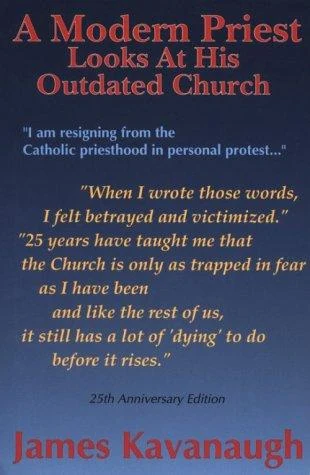
Read the decisions beneath the cover.
Make an insider critique specific by showing the conditions that sustain a failure and the earlier decisions the critic is now prepared to revise.
Especially useful for: Writers of institutional criticism or reflective nonfiction whose authority includes participation in the practices they question.
How the decisions work together
Kavanaugh moves from religious ideals and personal formation to institutions and pastoral decisions. The parish chapter links an ordinary communication failure to feedback and incentives. The legal-code chapter makes the narrator’s own previous counsel the object of a concrete retraction. Both operations give the argument more to inspect than a declaration of dissent; neither settles the disputed historical or religious claims.
- Establish the ideal and the insider
The opening argument and accounts of clergy and laity explain the standards and formation behind the critique.
- Test institutions against people
Parish government and successive pastoral domains bring impersonal rules into contact with reported lives.
- Make the critic answerable
Past counsel and prejudice reappear as decisions the narrator now revises.
- State what remains
The Epilogue names continuing faith and affiliation alongside the refusal of unquestioning assent.
2 decisions worth studying.
Start with the choice. Open its application and limits, or follow the source example.
Find the system behind the behavior
Show why an individual-level explanation or solution is incomplete, identify the surrounding incentives or interactions, and trace how they generate the observed outcome.
Explore the decision, application & limits
Why this choice matters
A complaint about an inept sermon changes into an account of why poor preparation can persist: parishioners have limited recourse, attendance and collections conceal departures, and training and rewards favor other work. That connection supports the book’s demand for institutional reform, though it does not prove the historical generalization.
Try the decision in your own work
- Begin with the recurring outcome and the individual explanation that cannot fully account for it.
- Trace the surrounding incentives or interactions, and distinguish explanation from evidence for the causal claim.
Let a failed expectation improve the explanation
Present a plausible explanation or expectation, show the observation or evidence gap it cannot account for, and return to the same question with a revised account that changes the later interpretation or application.
Explore the decision, application & limits
Why this choice matters
The retraction has a specific object: the author’s earlier instructions to a particular woman. Reported later distress and the changed counsel give his revision a practical consequence on the page, making responsibility more inspectable than a general admission of past rigidity.
Try the decision in your own work
- State the earlier explanation or expectation and why it seemed plausible.
- Identify the specific observation, objection or lack of evidence that requires a change, and credit its source.
- Return to the same question with the revised account; show how that revision changes the interpretation or later application.
Every chapter has a job.
Choose a section to see what it adds and which authoring decisions it makes visible.
Life in the Convent
Reported encounters with sisters lead into criticism of restrictions on consultation, adulthood and community life. The closing passage describes the mature service the author wants religious life to make possible.
Its job in the book
Extend the personalist critique to another form of religious formation.
A decision to study
Connect the criticism of restrictions to an affirmative picture of the work they should serve.
Supplied text · lines 5924–6372. Summary and role are our analysis.
Link to this chapterThe book’s subject and overall argument
Kavanaugh presents an insider’s argument that Catholic institutions have subordinated personal conscience and human relationships to rules, authority and inherited forms. Writing as a priest, he joins memories of his own formation to reported pastoral encounters and criticism of parish government, confession, courtship, marriage, birth control, schools and convent life. The argument repeatedly contrasts the Church he describes with the community of love and service he believes it should become.
The book also makes the critic’s own participation part of the case. Kavanaugh recalls enforcing restrictions whose consequences he later regretted, and he changes the counsel he is prepared to give. An Epilogue returns to childhood faith and declares his intention to remain Catholic while refusing unquestioning assent. This study examines the design of that historical religious argument; it does not establish the accuracy or present applicability of its theological, medical or institutional claims.
Move from the ideal and the formation of priests and laity into institutions and recurring pastoral problems. Alternate reported cases with interpretation, include the narrator among those who enforced the criticized arrangements, and close by stating the faith and affiliation he intends to retain.
Sources & reading scope
James Kavanaugh, A Modern Priest Looks at His Outdated Church; Inspected Trident Press, New York, text with copyright 1967 by Father James Kavanaugh; exact printing not established.
The completed whole-source synthesis and all four ordered segment summaries, section maps, qualifications and gaps supplied candidate observations. This Codex pass checked live family and source-scope gates before source access; inspected front matter, contents, every main chapter boundary, the complete Epilogue and the end of Notes; and read the admitted passage contexts. The current canonical dictionary, staged peers and base examples were checked. It is source-checked editorial review, not a second independently adjudicated whole-book reading.
- No human or independent-model review has been completed.
- The local extraction has not been compared page by page with a publisher edition; graphical layout and completeness are not independently certified.
- The book’s empirical and historical claims are described as claims made by the author, not independently verified findings of this study.
- Proposed effects on readers are editorial interpretations, not measured comprehension, behavior or longevity effects.
- This is a 1967 religious polemic and personal account. Claims about Catholic doctrine, governance, social conditions, psychological effects and reproductive health remain attributed to Kavanaugh; no present religious, clinical or legal advice is inferred.
- The pastoral encounters and conversations are presented by the author. This source check does not independently authenticate participants, dialogue, outcomes or representativeness, and no blanket composite-case or changed-name policy was established.
- The extraction includes damaged chapter typography, running heads and library matter. Clear contents titles, body sequence and notes headings support the map; graphical fidelity and page-by-page completeness are not certified. All thirteen main chapters and substantive Epilogue are present.
- The final printed address in Chapter 6 changes the author’s counsel but does not establish that he sent it, that its recipient followed it or that the reported harm was repaired.
- The Notes mix references with the author’s further judgments. Their presence does not independently substantiate every generalization in the main text.
Editorial source check by Codex. No human or independent-model review is claimed. Chapter locations refer to the supplied transcription, not printed page numbers.