My Years with General Motors
Explain how a large industrial enterprise developed and adjusted its management practices, using a participant’s account of decisions, failures and operating arrangements.
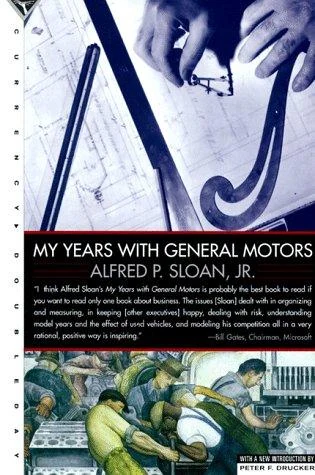
Read the decisions beneath the cover.
Make a managerial account answerable to its dated records and to failures that change how the principles must be put into practice.
Especially useful for: Writers of institutional history and professional memoir who need to explain a complex organization without turning later success into apparent inevitability.
How the decisions work together
The book moves from the formation of management concepts to their operation across functions. Its record-based method and consequential failure chapter offer a way to separate principle, contemporary intention and later assessment while keeping the executive viewpoint explicit.
- Declare the perspective
The front matter identifies the author’s role, collaborators, scope and three main explanatory concerns.
- Build concepts through history
Part One follows crises, product choices, coordination and finance, including a major failure of execution.
- Examine distinct functions
Part Two considers the product, technical organization, distribution, finance, geographic expansion and employment arrangements.
- Return to continuing judgment
The closing synthesis insists that a framework still depends on decisions made under changing circumstances.
2 decisions worth studying.
Start with the choice. Open its application and limits, or follow the source example.
Let failure change the working explanation
Present a plausible expectation, show the evidence it cannot accommodate, and return to the same problem with a revised account that changes the subsequent interpretation or response.
Explore the decision, application & limits
Why this choice matters
The engine episode follows chapters that have already explained the new management principles. Its failure prevents adopting those principles from functioning as a sufficient explanation: Sloan makes the division of responsibility and the means of cooperation into further problems that must be solved.
Try the decision in your own work
- State the expectation clearly enough that the failure can challenge something specific.
- Preserve the inconvenient outcome and the competing participants’ interpretations.
- Show what changes in the explanation and in the next decision, while identifying what the failure does not settle.
Place the dated record beside the later interpretation
Identify a contemporaneous document, preserve enough of its actual proposal or expectation to inspect, and distinguish it from later commentary about what happened or what the writer now understands.
Explore the decision, application & limits
Why this choice matters
A memoir’s smooth explanatory voice can make an unsettled decision appear obvious in advance. The dated document restores a prior state of thought, and the separate retrospective commentary can show both the reasoning available then and the limits revealed later.
Try the decision in your own work
- Choose a dated record whose actual reasoning matters to the narrative, not merely one that adds an air of documentation.
- Identify its author, occasion, edits and relation to the narrator; preserve the relevant uncertainty or alternatives.
- Follow it with clearly separate commentary specifying what later events confirmed, changed or left unresolved.
Every chapter has a job.
Choose a section to see what it adds and which authoring decisions it makes visible.
Personnel and Labor Relations
Personnel benefits and labor relations are treated as related but distinct subjects. The account traces the development of wage arrangements through management correspondence and argument.
Its job in the book
Explain the employment relationships underlying the enterprise from management’s perspective.
A decision to study
Separate the history of a policy from claims about whose interests it served.
Supplied text · lines 3482–3605. Summary and role are our analysis.
Link to this chapterThe book’s subject and overall argument
Alfred P. Sloan Jr. recounts the development of General Motors from the standpoint of a participant in its senior management. The first part links the company’s crises and growth with its organization, financial controls and approach to the automobile market. The second examines particular activities, including engineering, annual models, styling, distribution, credit, overseas operations, labor relations and executive compensation, before returning to the question of how management works.
The book combines a retrospective argument with reproduced letters, memoranda and committee records. Sloan treats coordination and divisional independence as a continuing problem of judgment, and includes failures that complicate the apparent neatness of his principles. His perspective remains that of an interested executive and shareholder selecting and interpreting an institutional record. The supplied edition credits John McDonald and Catharine Stevens prominently; its preface also describes substantial historical research and assistance.
First establish the historical problems behind the management concepts, then examine their operation across distinct functions. Alternating retrospective explanation with dated records lets the reader distinguish what managers proposed at the time from what Sloan later concluded, while the failure chapters keep adoption of a principle separate from making it work.
Sources & reading scope
Alfred P. Sloan Jr., My Years with General Motors; supplied eNet Press digital edition, 2015, ISBN 978-1-61886-397-3; original copyright 1963; edited by John McDonald with Catharine Stevens.
The completed whole-source AI synthesis supplied candidate observations and the broad argument map. This Codex editorial pass checked original source headings, section boundaries, openings and selected argumentative contexts; inspected every retained example; checked the existing pattern dictionary and base examples; and rewrote or rejected nominations. It is a source-checked editorial pass, not a new independently adjudicated whole-book reading.
- No human or independent-model review has been completed.
- The local extraction has not been compared page by page with a publisher edition; graphical layout and completeness are not independently certified.
- The book’s empirical and historical claims are described as claims made by the author, not independently verified findings of this study.
- Proposed effects on readers are editorial interpretations, not measured comprehension, behavior or longevity effects.
- All twenty-four main chapters are present and mapped, together with the Preface and Introduction. Part One covers Chapters 1–11; Part Two begins before Chapter 12. The publisher Author Page, Index and promotional Preview are separately identifiable end or front matter.
- The title page identifies Sloan as author, John McDonald as editor and Catharine Stevens as collaborator. The preface describes their substantive roles and Alfred D. Chandler’s work as consulting historian and research associate. The first-person narration does not establish sole authorship of every prose decision.
- The eNet Press edition says charts and photos from the print edition are available in separate supplements. Those supplements were not inspected; the text and its references do not certify graphic completeness, table layout or fidelity to the original print pages.
- The account and its historical economic, technical, legal and labor claims belong to Sloan and the documents he selects. This study does not independently verify them or endorse management prescriptions, product safety claims or the adequacy of his account of affected workers.
- The publisher Author Page includes later evaluative claims about Sloan and the book. They are not attributed to Sloan or used as evidence for the retained craft lessons.
- The whole-source AI draft misnamed Chapter 12 and shortened or altered other headings. This record uses the actual source headings; the draft also incorrectly described the preface as disclaiming final responsibility, whereas Sloan explicitly accepts it.
Editorial source check by Codex. No human or independent-model review is claimed. Chapter locations refer to the supplied transcription, not printed page numbers.