Poverty, by America
Understand the author’s account of how ordinary economic and civic arrangements reproduce poverty, and how changing those arrangements would alter the problem.
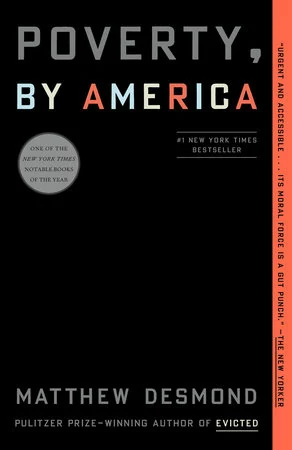
Read the decisions beneath the cover.
Make the explanation inspectable, then give the proposed remedies the job of changing the mechanisms the book has established.
Especially useful for: Writers developing a consequential public argument that moves from diagnosis to action while addressing readers who may be implicated in the problem.
How the decisions work together
The book first establishes poverty’s compounded harms and asks why they persist. It then shifts attention from the poor alone to labor arrangements, housing and finance, public subsidy, and protected opportunity. Calculations and constrained choices make parts of that diagnosis inspectable. The solution sequence returns to those mechanisms, making public investment, power and access answer different parts of the argument. The epilogue asks readers to turn those commitments into collective action. This is an account of the argument’s design, not an independent policy verdict.
- Change what needs explaining
Establish the harms and move the question from poverty’s victims alone to the arrangements and beneficiaries around them.
- Trace the mechanisms
Develop labor, housing, finance, public subsidy and exclusion through reporting, comparisons and explicit reasoning.
- Make remedies answer the account
Connect public investment, greater choice and integrated opportunity to the mechanisms, then invite organized action.
3 decisions worth studying.
Start with the choice. Open its application and limits, or follow the source example.
Let the reader reconstruct the inference
Present concrete inputs and the intermediate reasoning steps that connect them to a conclusion, including a revealing wrong move or alternative where available.
Explore the decision, application & limits
Why this choice matters
Showing what was subtracted, what might still be missing and how the estimate changes makes the claim inspectable. Here the reader can distinguish a reported calculation from the author’s larger interpretation of exploitation.
Try the decision in your own work
- State the quantities and the operation producing the comparison.
- Give a plausible omitted factor a fair test and show what changes.
- State where the resulting comparison stops holding.
Find the system behind the behavior
Show why an individual-level explanation or solution is incomplete, identify the surrounding incentives or interactions, and trace how they generate the observed outcome.
Explore the decision, application & limits
Why this choice matters
Explaining why a seemingly available option is inaccessible changes the reader’s question from personal choice to the conditions of choice. The connection between constraints and continuing costs is the analytical step worth inspecting.
Try the decision in your own work
- State the apparently simple alternative a reader is likely to propose.
- Trace the entry barriers and incentives that restrict it.
- Connect the restricted alternatives to the recurring outcome, preserving cases where the account may differ.
Make proposed remedies answer the diagnosis
Condense the book’s causal diagnosis into distinct mechanisms, then make each major proposed remedy answer one of those mechanisms and return to the mapping near the close.
Explore the decision, application & limits
Why this choice matters
A causal map can give an intervention sequence a reason to exist: readers can assess whether each remedy addresses a problem the book has actually established. The alignment is visible here even though the effectiveness of the remedies requires separate evidence.
Try the decision in your own work
- Write the diagnosed mechanisms as distinct claims before drafting the solution sequence.
- Give each remedy an explicit mechanism to change and explain what an earlier remedy leaves unresolved.
- Return to the mapping at the end, without making a tidy outline stand in for evidence of effectiveness.
Every chapter has a job.
Choose a section to see what it adds and which authoring decisions it makes visible.
PROLOGUE
Desmond describes the personal and reporting experiences that led him to ask why poverty persists amid abundance. He redirects that question toward people and institutions that enjoy security and asks readers to examine their own involvement.
Its job in the book
Establish the inquiry and the audience’s stake in it.
A decision to study
Tell readers what the book must explain beyond describing the visible victims of the problem.
Supplied text · lines 134–167. Summary and role are our analysis.
Link to this chapterThe book’s subject and overall argument
Matthew Desmond asks why a wealthy United States continues to produce so much poverty, then changes the object of inquiry: the lives of people in poverty cannot, by themselves, explain the arrangements that keep them there. After showing poverty as accumulated insecurity and harm, he examines labor, housing, finance, public benefits and segregated opportunity. His argument repeatedly connects disadvantages for one group with gains or protections for another.
The last three chapters turn that diagnosis into proposals concerning public investment, bargaining and choice, and access to prosperous communities. Personal reporting, social-science findings and sharply stated questions keep the analysis addressed to readers who may benefit from the arrangements being criticized. An epilogue turns the proposals into an invitation to collective action. This study examines how the argument is built; it does not independently endorse the book’s statistics, policy estimates or explanations of poverty.
Define the stakes, question familiar explanations, develop several mechanisms, and make the proposed remedies answer those mechanisms. The affluent reader’s involvement supplies continuity across the changing policy domains.
Sources & reading scope
Matthew Desmond, Poverty, by America; supplied local ebook text identifying First edition, Crown, 2023, ebook ISBN 9780593239926.
The completed whole-source AI synthesis supplied candidate observations and the broad argument map. This Codex editorial pass checked original source headings, section boundaries, openings and selected argumentative contexts; inspected every retained example; checked the existing pattern dictionary and base examples; and rewrote or rejected nominations. It is a source-checked editorial pass, not a new independently adjudicated whole-book reading.
- No human or independent-model review has been completed.
- The local extraction has not been compared page by page with a publisher edition; graphical layout and completeness are not independently certified.
- The book’s empirical and historical claims are described as claims made by the author, not independently verified findings of this study.
- Proposed effects on readers are editorial interpretations, not measured comprehension, behavior or longevity effects.
- The main argument ends with its Epilogue at source line 1284. The later reader guide and appended Evicted prologue are supplementary material, not additional chapters or the ending of Poverty, by America.
Editorial source check by Codex. No human or independent-model review is claimed. Chapter locations refer to the supplied transcription, not printed page numbers.