Second Tree from the Corner
Encounter a varied, personally voiced collection in which humor and departure repeatedly change the meaning of ordinary things, familiar practices and the language used to describe them.
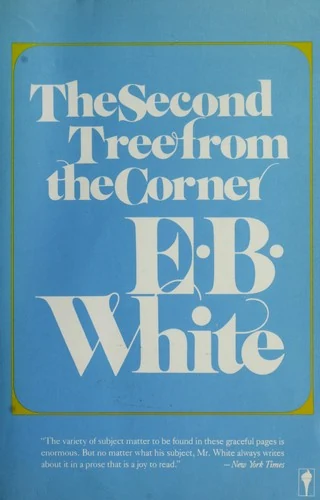
Read the decisions beneath the cover.
A collection can preserve an earlier work while stating what no longer holds, and a local scene can make a revised judgment visible through a changed action.
Especially useful for: Writers assembling mixed-form collections or developing reflective pieces in which language meets consequences it did not anticipate.
How the decisions work together
White gives the miscellany a candid editorial frame and preserves the variety of its forms. The strongest reusable operations here concern revising a reader’s or actor’s understanding: a named update leaves the earlier poem inspectable, and a practical procedure is reconsidered through an overlooked consequence. Both keep the limits of the revision visible.
- Explain the collection’s choices
The Note and Foreword identify sources, attribution, selection and revisions, and propose an undertone of farewell.
- Move through different kinds of time
Recollection and speculative stories precede contemporary notes and scenes.
- Turn toward writing and verse
Parodies, craft commentary, criticism and nine poems vary the forms of attention.
- Return to places and living creatures
City memory leads toward hens, a changed pastoral action and the final account of the pig’s death.
2 decisions worth studying.
Start with the choice. Open its application and limits, or follow the source example.
Keep the earlier work beside a specific correction
Retain an identifiable earlier account, connect it to a clearly later revision, and state what new evidence changes or leaves unresolved so readers can distinguish the two states of knowledge.
Explore the decision, application & limits
Why this choice matters
The Foreword names the particular poem and the information that prompted it, then reports what overtook that information. A reader can distinguish the preserved literary work from the earlier premise that White no longer presents as current; the qualification does not require the poem’s emotional or satirical purpose to disappear.
Try the decision in your own work
- Identify the earlier work and the premise affected, then state what later evidence or event changed the account.
- Make the correction easy to connect with the retained piece; distinguish a factual update from the interpretation or feeling the work expresses.
- Explain the limits of the new evidence and choose a location where readers of the old passage can find the qualification.
Let an overlooked consequence change the action
Present a plausible explanation or expectation, show the observation or evidence gap it cannot account for, and return to the same question with a revised account that changes the later interpretation or application.
Explore the decision, application & limits
Why this choice matters
In Pasture Management, the instructions continue to speak confidently while the speaker’s encounter with the berries changes his judgment. The revision becomes visible in an action—putting the pump away—and the last sales notice leaves the disagreement between the two registers unresolved.
Try the decision in your own work
- Establish the initial expectation through the actor’s choices or the procedure they accept, rather than announcing only the final regret.
- Show the specific consequence that changes the judgment and make the subsequent action observable.
- If another voice continues to promote the procedure, preserve its distinct status; do not imply that a personal reassessment is experimental disproof.
Every chapter has a job.
Choose a section to see what it adds and which authoring decisions it makes visible.
NOTE
The publication Note identifies prior magazine venues and works from which introductions or prefaces were taken. It also names the collaboration behind Farewell, My Lovely! and identifies Zoo Revisited as newly published here.
Its job in the book
Set the provenance and attribution boundaries of the collection.
A decision to study
Keep a collected work’s prior occasions and collaborations visible.
Supplied text · lines 75–94. Summary and role are our analysis.
Link to this chapterThe book’s subject and overall argument
White assembles essays, stories, parodies, editorial notes and verse into five groups about time, modern life, literature, song, and the city and country. His Foreword finds a recurring impulse toward revisiting and farewell in material that originally served different occasions. The book moves between comic distortion, remembered encounters, public commentary and personal loss; its scenes and speakers do not all make the same kind of factual claim.
The collection also makes its editorial choices visible. White explains retained anonymous-page language, removed dates, changed names and limited revisions, and identifies information that overtook one poem’s premise. Several pieces put an apparently sufficient way of seeing under pressure. Near the end, Pasture Management alternates technical prose with a speaker’s changed judgment, and Death of a Pig follows care and bereavement through the breakdown of a familiar farming routine.
Use five broad groupings and a candid Foreword to orient a miscellany, while letting its essays, stories, note sequences and verse keep different forms. The route moves from remembered and imagined time through public life and writing, then toward city memory, animals and a final account of loss.
Sources & reading scope
E. B. White, Second Tree from the Corner; Inspected Harper & Brothers text titled The Second Tree from the Corner, with copyright notices through 1954 and Library of Congress card number LC 53-11864; printing not otherwise established.
The completed whole-source synthesis and all four segment summaries, section maps, qualifications and gaps supplied candidates. This Codex pass checked live family and source-scope gates before accessing the source, inspected the publication Note, Foreword, contents, all top-level and nested piece headings, part boundaries and final prose, and read the complete admitted contexts, including the retained Queen Bee poem and all of Pasture Management. Current 42 canonical definitions, staged peers and base examples were compared. This is source-checked editorial review, not a second independently adjudicated whole-book reading.
- No human or independent-model review has been completed.
- The local extraction has not been compared page by page with a publisher edition; graphical layout and completeness are not independently certified.
- The book’s empirical and historical claims are described as claims made by the author, not independently verified findings of this study.
- Proposed effects on readers are editorial interpretations, not measured comprehension, behavior or longevity effects.
- The collection mixes nonfiction, fiction, satire, parody and verse. A narrator, persona, imagined event or poetic consequence is not treated as an independently verified biographical, clinical or historical fact. Scientific and technical language remains attributed to the text.
- The source has damaged OCR in several headings and interstitial regions. Clear contents entries, sequence and body context establish the displayed titles; source spelling and original graphic typography have not been page-verified. All five parts, 35 top-level pieces and three complete nested note sequences are identifiable, with substantive final prose ending at LF8044.
- The publication Note credits prior venues and adaptations. Farewell, My Lovely! is explicitly a collaboration with Richard L. Strout. The copyright for the introduction to A Subtreasury of American Humor names E. B. White and Katharine S. White; this does not establish each person’s contribution to the excerpt reprinted here.
- White says most pieces retain their original form, with some revisions and name changes. No original magazine texts, manuscripts, recordings or the graphic evidence mentioned in the Foreword were independently compared with this extraction.
- The Foreword correction concerns an earlier factual premise of a satirical poem. It is not a current account of bee breeding, and keeping the poem does not claim that its speaker’s wishes are a scientific prediction. Pasture Management provides a depicted revision of judgment, not a herbicide experiment or present agricultural advice.
Editorial source check by Codex. No human or independent-model review is claimed. Chapter locations refer to the supplied transcription, not printed page numbers.