The Sea Around Us
Make the sea intelligible as a connected, changing world whose processes reach into the land, living things and human affairs, while inviting imaginative attention to regions readers cannot directly enter.
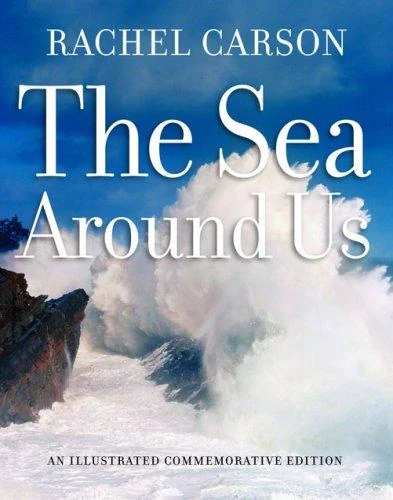
Read the decisions beneath the cover.
Make a hidden world understandable by exposing the reasoning from traces, and make later changes to that understanding traceable to the claims they revise.
Especially useful for: Writers of natural history, scientific synthesis and annotated reissues who need vivid reconstruction without blurring observation, speculation and revision.
How the decisions work together
Carson organizes the sea from origins and environments through motion to human dependence. The inspected edition adds a second reading task: relating earlier accounts to later knowledge. Its strongest transferable decisions concern how to expose those relationships, with explicit limits on what the evidence supports.
- Origins and environments
Mother Sea moves through beginnings, living waters, hidden landscapes, sediments, islands and changing boundaries.
- Forces and movement
The Restless Sea follows waves, currents and tides through mechanisms and particular observations.
- Human relations
Man and the Sea About Him connects circulation, resources and navigation to the wider physical history.
- A visible revision layer
The 1961 preface and chapter-linked notes qualify selected accounts; this edition explains its relocation of the notes to chapter ends.
2 decisions worth studying.
Start with the choice. Open its application and limits, or follow the source example.
Make later revisions traceable to earlier claims
Retain an identifiable earlier account, connect it to a clearly later revision, and state what new evidence changes or leaves unresolved so readers can distinguish the two states of knowledge.
Explore the decision, application & limits
Why this choice matters
This edition lets readers encounter both the force of an earlier explanation and the findings that qualify it. A visible link gives the revision a specific target; it also reveals the cost of keeping an older account intact when a reader might miss the correction.
Try the decision in your own work
- Identify the precise earlier claim affected by a revision, and give the revision a clear time or edition context.
- Make the connection easy to follow and state whether the change is a new estimate, a narrowed scope or an unresolved contradiction.
- Choose deliberately whether the old passage should remain visible; if retaining it could mislead, put the current qualification where a reader cannot reasonably miss it.
Let the reader reconstruct the inference
Present concrete inputs and the intermediate reasoning steps that connect them to a conclusion, while distinguishing direct observation, reconstruction and plausible alternatives.
Explore the decision, application & limits
Why this choice matters
Carson’s ocean often lies beyond direct view or remembered history. Exposing the link from traces to interpretation gives readers a way to inspect those accounts: surf can suggest an origin, and recovered materials can support a former landscape, without every surrounding narrative detail acquiring the same evidentiary status.
Try the decision in your own work
- Separate the observed trace from the history or mechanism inferred from it.
- Show the relationship that makes the trace informative and retain an alternative or uncertainty that could change the interpretation.
- After a worked explanation, specify what a reader could infer and what remains an imaginative or provisional reconstruction.
Every chapter has a job.
Choose a section to see what it adds and which authoring decisions it makes visible.
The Long Snowfall
A sustained snowfall image introduces the sources, distribution and accumulation of marine sediments. Instruments and cores make those deposits readable as records, while a later note makes unexpectedly thin accumulation a problem for the earlier account.
Its job in the book
Turn a slow, nearly invisible process into both an image and an archive of change.
A decision to study
Let an organizing image carry the explanation while retaining observations that complicate its expectations.
Supplied text · lines 721–779. Summary and role are our analysis.
Link to this chapterThe book’s subject and overall argument
Rachel Carson presents the ocean as an interconnected world with a history, inhabitants, physical movements and consequences for life on land. The first part moves from an account of origins through surface and deep-water life to undersea landscapes, sediments, islands and changing sea boundaries. The second follows waves, currents and tides; the third connects the sea with climate, mineral resources and the history of navigation. Scientific explanations are interwoven with imagined scenes, reported observations and literary language.
The inspected edition also preserves a visible history of changing knowledge. Its 1961 preface describes discoveries made since the book appeared and argues that radioactive waste threatens a sea people had treated as beyond their power to damage. Revision notes, placed at the ends of corresponding chapters in this edition, alter or qualify selected accounts in the main narrative. This study reads the scientific quantities and theories as claims in those historical layers, including their disagreements and uncertainties, rather than as a current oceanography reference.
Move from origins and living environments to the forces that move the ocean, then to human dependence on it. Concrete traces and imagined processes make inaccessible events readable; the preface and linked revision notes make selected changes in the book’s own knowledge visible.
Sources & reading scope
Rachel Carson, The Sea Around Us; supplied Open Road Integrated Media ebook, publication statement 2011, ISBN 9781453214763; includes the Preface to the 1961 Edition and revision notes alongside the earlier narrative.
The completed whole-source AI synthesis supplied candidate observations and the broad argument map. This Codex editorial pass checked original source headings, section boundaries, openings and selected argumentative contexts; inspected every retained example; checked the existing pattern dictionary and base examples; and rewrote or rejected nominations. It is a source-checked editorial pass, not a new independently adjudicated whole-book reading.
- No human or independent-model review has been completed.
- The local extraction has not been compared page by page with a publisher edition; graphical layout and completeness are not independently certified.
- The book’s empirical and historical claims are described as claims made by the author, not independently verified findings of this study.
- Proposed effects on readers are editorial interpretations, not measured comprehension, behavior or longevity effects.
- The source contains the 1961 preface, all fourteen main chapters under three part headings, Suggestions For Further Reading, Acknowledgments and publisher biography/copyright material. The map includes the preface and main chapters; other end matter is not invented as additional chapters.
- The filename says 2010, but the source publication statement at LF 2037 says 2011 and its ISBN at LF 2035 is 9781453214763. This study uses the internal publication statement.
- The preface is dated October 1960 and headed Preface to the 1961 Edition. Its reference to revision notes in an appendix is followed by an editorial note at LF 116 explaining that this edition places them at corresponding chapter ends. Placement is therefore attributed to this edition, not asserted as Carson’s original design.
- Selected earlier passages remain next to later revisions, but this review did not compare the entire text with a 1951 edition and cannot certify that every original paragraph is unchanged. The notes do not constitute a comprehensive update to present-day science.
- Scientific theories, climate descriptions, species counts, historical accounts and environmental hazards are presented as the source’s claims. This editorial study neither adjudicates them nor offers current scientific or policy advice.
- The literary epigraphs and embedded quotations have their own attributed authors. No borrowed poem or epigraph is reproduced in this study.
Editorial source check by Codex. No human or independent-model review is claimed. Chapter locations refer to the supplied transcription, not printed page numbers.