Anyone Can Make a Million
Learn the author’s proposed routes through speculative markets and recognize the practices he says investors should avoid.
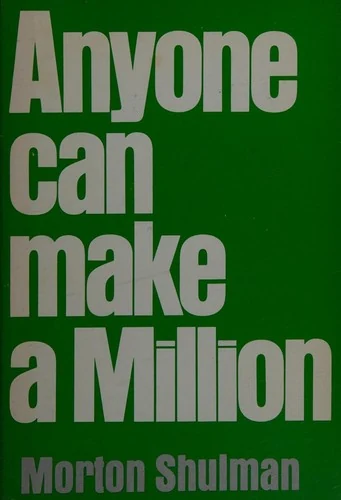
Read the decisions beneath the cover.
Separate a favorable result from its explanation, and mark the boundary when later guidance reverses an earlier rule.
Especially useful for: Writers organizing practical material across contexts where memorable rules may be overgeneralized, or where success stories can be mistaken for proof.
How the decisions work together
The guide moves through 21 instrument and investment chapters. Its strongest retained decisions concern what an outcome can establish and when a rule changes scope. The financial assertions belong to the 1966 source; reproduced documents and final plates are not available here as inspectable images.
- Define the intended reader
Contrast conventional investing with the speculative arena the author intends to teach.
- Develop categories through cases
Combine instrument explanations with personal accounts and explicitly invented illustrations.
- Mark the change of context
Recall and reverse earlier guidance when entering the commodity setting.
- Return to selection and avoidance
Close by condensing both favored choices and the practices the author rejects.
2 decisions worth studying.
Start with the choice. Open its application and limits, or follow the source example.
Let a successful outcome lose its apparent explanation
Present a plausible explanation or expectation, show the observation or evidence gap it cannot account for, and return to the same question with a revised account that changes the later interpretation or application.
Explore the decision, application & limits
Why this choice matters
The reported sale first appears to confirm a well-connected tip. The friend’s admission that he named the wrong company breaks that explanation while leaving the profit intact, giving the reader a concrete reason to distinguish outcome from the account used to justify the decision.
Try the decision in your own work
- Establish the reason the decision seemed justified before revealing its outcome.
- Include the later fact that the original explanation cannot accommodate, even when the result was favorable.
- Return to what the outcome can and cannot support; do not turn one correction into an unsupported universal rule.
Flag a rule change when the context changes
Recall an earlier recommendation when entering a materially different context, explicitly change or reverse it, and state the condition meant to explain the switch.
Explore the decision, application & limits
Why this choice matters
In a book organized by instrument, a reader may carry a memorable rule from one chapter into another. Naming the earlier instruction and the proposed reason for its reversal gives that reader a visible boundary on transfer instead of leaving two contrary directives disconnected.
Try the decision in your own work
- Identify the earlier instruction precisely enough that readers can recognize what is changing.
- Name the new context and the relevant condition that is meant to make the earlier instruction unsuitable.
- State the replacement instruction and retain the limits of the evidence for the claimed difference.
Every chapter has a job.
Choose a section to see what it adds and which authoring decisions it makes visible.
6. Puts and Calls
Definitions of options lead into mechanics, examples and Shulman’s reported loss on option selling. The close distinguishes limited possibilities from a broad warning against the category.
Its job in the book
Make an unfamiliar instrument’s mechanics precede the verdict.
A decision to study
Preserve the difference between an example of loss and a population-level risk estimate.
Supplied text · lines 3042–3351. Summary and role are our analysis.
Link to this chapterThe book’s subject and overall argument
Shulman presents an instrument-by-instrument guide to speculation, combining definitions, personal trading accounts, illustrative fraud stories and blunt verdicts. The sequence begins with supposedly safe investments, exposes promotional traps, develops favored instruments and then moves through commodities, currencies, insurance, property and collectibles. The conclusion returns to convertible securities and emphasizes avoiding unsuitable investments.
Two decisions make the book useful for a writer to inspect without accepting its financial claims. A profitable hot-tip trade is retold so that a late correction undercuts the apparent reason for the gain. Elsewhere, the book explicitly recalls and reverses its earlier stop-loss guidance when entering the commodity market, attaching the change to a stated difference in conditions.
Twenty-one chapters organize the material by instrument or investment setting, with repeated definitions, cases and closing rules. A return to earlier guidance becomes especially important when the commodity chapter asks readers to use an instruction that the stock chapter rejected.
Sources & reading scope
Morton Shulman, Anyone Can Make a Million, supplied 1966 McGraw-Hill book-club transcription; inclusive LF anchors.
Passed live development-family and source-scope gates before access. Read the complete whole-source AI synthesis and all five ordered segment summaries, maps, observations, rejected candidates, qualifications and gaps. Compared all 21 main chapters with the contents, inspected their openings and endings, and checked foreword, preface, conclusion and the absent plate bodies. Read the full hot-tip narrative, the original stop-loss argument and its later commodity-market reversal. This is a source-checked editorial pass, not a second full reading, independent review, financial audit or verification of historical transactions.
- The supplied book-club transcription identifies McGraw-Hill and copyright 1966. No publisher-controlled copy or alternative edition was compared.
- All 21 main chapters, foreword, preface and substantive conclusion are represented. Some extracted numerals and the Stop Loss opening title are damaged; the contents and running headings identify those chapters. No demonstrated missing main-prose continuation was found at the inspected boundaries.
- Trade confirmations, tables, charts and forms survive mainly as garbled OCR, and final illustration plates have labels without images. The study assesses the prose and the announced use of documents; it does not authenticate slips, prices, arithmetic, visual layout or the complete illustrated edition.
- Financial instruments, rules, regulations, forecasts and reported outcomes are the author’s presentation in this 1966 text. The study supplies craft analysis, not current financial advice or evidence that any method is profitable, low-risk or lawful today.
- The author’s trades are a selected first-person account. A recorded gain does not validate the explanation assigned to it, and the historical stories, quoted speech, documents and returns were not independently checked.
- The Chapter 2 footnote identifies fictitious names used to illustrate a recurrent situation. It does not establish that the stories are composites of documented cases, nor does it verify the claimed frequency of the schemes.
- The explicit stock/commodity rule switch is supported in the text, but the claimed difference in market behavior is not empirically tested here. Other categorical promises and forecasts should not inherit credibility from this local disclosure.
- Reader effects and writer usefulness are editorial interpretations. No reception, causal reader-response, independent-review or untouched-holdout claim is made.
Editorial source check by Codex. No human or independent-model review is claimed. Chapter locations refer to the supplied transcription, not printed page numbers.