Campaign persuasion must confront the ability to withhold support
A book can grow by changing the scale of the question while keeping its central idea in view.
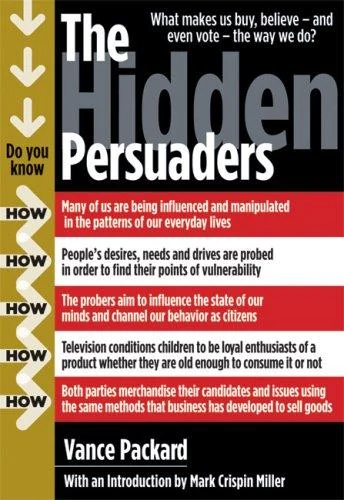
The Hidden Persuaders
Vance Packard · 50 weeksCampaign persuasion must confront the ability to withhold support
SHORT SOURCE EXCERPT“citizens of a free society”
After the previous chapter explicitly announces the move beyond merchandising, the political chapter distinguishes manipulation in a controlled society from influencing citizens who can reject a solicitation or vote a candidate out. It then describes campaign uses of advertising techniques and image construction.
The new setting changes the problem of persuasion: what is sought is political support from an audience described as able to refuse it. The book can therefore carry its central concern forward without treating the political chapter as only another product category.
The source in context.
Packard applies the account of persuasion to campaign images, candidates and voting. He distinguishes the problem of influencing citizens able to withhold support from manipulation in a controlled society.
Open this chapterWhat this example supports
The new setting changes the problem of persuasion: what is sought is political support from an audience described as able to refuse it. The book can therefore carry its central concern forward without treating the political chapter as only another product category.
Its limit
Packard’s historical claims and reports of campaign prediction or influence are not independently verified here. The passage does not establish that commercial methods determine electoral outcomes or transfer unchanged into politics.
Source & edition
Vance Packard, The Hidden Persuaders; supplied Ig Publishing ebook, eISBN 978-1-935-43953-0, with Mark Crispin Miller’s introduction copyright 2007; Packard text copyright 1957 and 1980; local filename dated 2011.
Supplied text, lines 1581–1593. The short quotation is checked against the source.
The completed whole-source AI synthesis supplied candidate observations and the broad argument map. This Codex editorial pass checked original source headings, section boundaries, openings and selected argumentative contexts; inspected every retained example; checked the existing pattern dictionary and base examples; and rewrote or rejected nominations. It is a source-checked editorial pass, not a new independently adjudicated whole-book reading.
supplied Ig Publishing ebook, eISBN 978-1-935-43953-0, with Mark Crispin Miller’s introduction copyright 2007; Packard text copyright 1957 and 1980; local filename dated 2011