Good to Great
The book promises a disciplined explanation of how a good organization can become substantially better, and a vocabulary for deciding which changes deserve sustained effort.
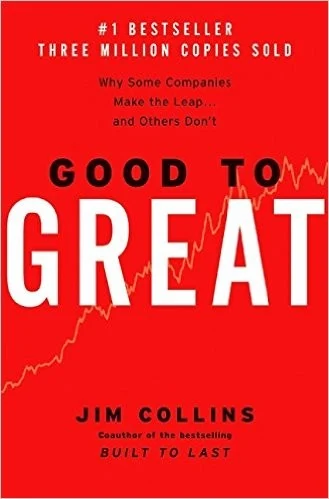
Read the decisions beneath the cover.
Make a multipart framework feel like one developing argument by connecting its cases, decision images, chapter recaps, and account of cumulative change.
Especially useful for: Writers turning a body of case research into a practical framework with several related concepts or stages.
How the decisions work together
The promise is to explain how an established organization can become substantially better. A preview supplies the whole framework before chapters develop leadership, people, disciplined thinking, and action through selected company cases and contrasts. Concrete figures such as the bus and hedgehog connect the concepts to decisions, while recaps distinguish core claims from surprises. The flywheel brings separate actions into an account of cumulative momentum, and the closing material reconnects the framework with enduring organizations and meaningful work. This is the book's explanatory design, not independent validation of its management claims.
- Show the whole framework
Present the motivating question, comparison design, and conceptual overview so readers know what the chapters will develop.
- Develop distinct decisions
Use cases, contrasts, recurring images, and recaps to explain the parts of the framework.
- Reconnect the parts
Bring sustained actions together through the flywheel account and connect the framework to the book's broader concluding questions.
3 decisions worth studying.
Start with the choice. Open its application and limits, or follow the source example.
Make an idea concrete before its formal unpacking
A local case exhibits the traits that the following explicit explanation brings together, even if a title or earlier preview has already named the concept.
Explore the decision, application & limits
Why this choice matters
The case gives the later definition a specific referent: readers can connect each abstract trait to actions they have just encountered. This is an interpretation of the sequence, not a measured comprehension effect.
Try the decision in your own work
- Choose a case whose actions show both sides of the concept.
- Place the fuller definition immediately after the case’s consequential decision.
- Check earlier titles and previews so you describe the actual sequence accurately.
Turn a metaphor into decisions readers can distinguish
The same image identifies a sequence of actions and is reused to clarify a later decision boundary.
Explore the decision, application & limits
Why this choice matters
The repeated image can help a reader keep the relation among actions in view instead of remembering only a catchy phrase. The prose must still supply the criteria the image omits.
Try the decision in your own work
- Assign distinct real decisions to the image’s actions.
- State the order of those decisions and explain why the order matters.
- Return to the image when explaining an exception or a frequently confused case.
Give the recap two separate jobs
A chapter close distinguishes its core takeaways from findings presented as surprising or contrary to expectation.
Explore the decision, application & limits
Why this choice matters
Readers get both a retrieval aid and a signal about which expectations the chapter is challenging. This describes the editorial purpose of the two groups rather than proof that the format improves memory.
Try the decision in your own work
- Write the essential explanation as a compact first group.
- Reserve the second group for a clear change to an expected belief.
- Keep necessary qualifications near the recap or point readers back to them.
Every chapter has a job.
Choose a section to see what it adds and which authoring decisions it makes visible.
A Culture of Discipline
Collins distinguishes a durable culture of self-discipline from discipline imposed by a dominant individual. The chapter ties action to the three-circle focus and makes stopping activities part of the argument.
Its job in the book
Specify how the preceding focus should constrain everyday action.
A decision to study
Define the misleading near-neighbor of your idea so a reader cannot adopt its label while doing the opposite.
Supplied text · lines 3959–4792. Summary and role are our analysis.
Link to this chapterThe book’s subject and overall argument
Jim Collins asks how an established company can move from adequate performance to sustained exceptional results. He presents a retrospective comparison of eleven selected companies with direct and unsustained comparison cases, then organizes the reported differences into a progression: leaders and personnel, clear-eyed thinking and focus, disciplined action, and cumulative momentum. The companies function as recurring evidence for the framework, rather than as separate biographies.
The book gives this large argument several handles: the bus, the hedgehog, the three circles, and the flywheel. Individual chapters mix company narratives, explicit distinctions, and condensed recaps; the final chapter connects the framework to Built to Last and broadens the question to meaningful work. An epilogue and research appendices expose objections and selection procedures. These are observable features of the book’s teaching design, not independent confirmation that its management claims hold universally.
Preview the whole framework, develop its parts through cases and contrasts, and finally reconnect the parts as one accumulating process. Repeated metaphors and chapter recaps make the argument portable between those levels.
Sources & reading scope
Jim Collins, Good to Great; inspected local source text, local electronic-text extraction with a 2001 copyright notice; print pagination and graphical layout not verified.
Codex editorial pass used the existing whole-source AI draft as a set of nominations, checked the original local source at every quoted example and its surrounding passages, checked chapter headings and section order, and rewrote or narrowed the selected interpretations. Chapter maps combine that draft with direct checks of headings, openings, and selected passages; this pass is not a new page-by-page reading or an independent-model review.
- No human review or independent-model review has been completed.
- The local extraction has not been compared against a publisher-controlled edition for completeness or layout fidelity.
- Craft effects are interpretations of textual structure, not measured effects on readers or explanations of sales.
- Claims made inside the book are attributed to the book; this editorial pass does not independently validate its empirical findings.
- The body previews and defines Level 5 Leadership in Chapter 1; Chapter 2’s Darwin Smith scene precedes a fuller local definition, not the first appearance of the term. The draft’s stronger delayed-label claim was rejected.
Editorial source check by Codex. No human or independent-model review is claimed. Chapter locations refer to the supplied transcription, not printed page numbers.