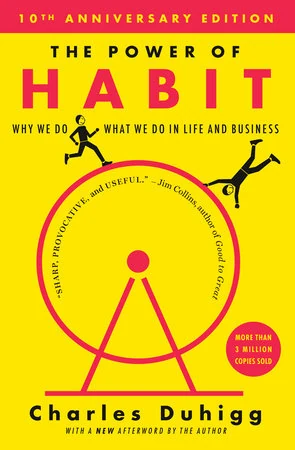
A BOOK, READ FROM THE INSIDE OUT

The Power
of Habit.

Why We Do What We Do in Life and Business

One book. Ten decisions worth studying.
How an idea becomes a model, a sequence of stories, and a method readers can use.

2012Original publication
34 weeksTarget Zone CSV
9 chaptersPlus prologue & appendix
THE BOOK / THE DECISIONS01
The Power of Habit coverAn everyday
question.
A model you
can reuse.
An explanation
that keeps developing.
Topic → model → story → applicationStudy the choices beneath the cover.
Complete supplied text reviewedCraft lessons · Longevity effect untested
WHAT AN AUTHOR CAN LEARN HERE

Let a starting model earn its reach: use it to inspect cases, revise it where needed, and end by showing how someone investigates a real problem with it.

Especially useful for: Writers introducing an explanatory model that must remain recognizable as the book moves across cases, scales, and applications.

How the decisions work together

The promise is to make repeated behavior understandable and open to investigation. Cue, routine, and reward provide an initial set of questions; subsequent cases and failed explanations add distinctions rather than merely repeating the diagram. The three parts move from individuals to organizations and societies, placing the model alongside new conditions and questions of responsibility. Recurring cases give later explanations something familiar to revise. The appendix completes the practical arc with the author's cookie routine, competing explanations, observations, and an adjusted plan: the reader sees a diagnosis being worked through.

  1. Make behavior inspectable

    Introduce components that readers can locate in a case, then use unresolved examples to refine the explanation.

  2. Increase the scale

    Move through individual, organizational, and societal settings while introducing the additional conditions those settings require.

  3. Work through a diagnosis

    Use the appendix's cookie account to show competing explanations, observations, tests, and a plan that can be adjusted.

THE BOOK IN TWO PARAGRAPHS

A familiar subject.
A developing explanation.

Duhigg argues that repeated behavior becomes easier to understand when we can identify its components and the conditions that keep it going. He begins with individuals, moves into organizations, and then asks how habits interact with collective action and responsibility.

For a writer, the book offers more than a familiar three-part diagram. Its chapters repeatedly improve an explanation, bring a case back with a new job, and make large claims tangible through small actions. The appendix then lets readers watch the author use the method—including his wrong guesses and setbacks.

The lessons below concern how the book is made. They are candidates for broader comparison, not established causes of bestseller longevity.

THE DECISIONS BENEATH THE FINISHED BOOK

Ten lessons.
More than one way in.

Start with a short explanation and a visual. Open the deeper dive for specific cases, an analogy, concrete writing decisions, and the limits of the lesson.

Ten decisions in this book; their effects have not been scored.
01
Topic & central idea

Choose a subject readers meet again tomorrow.

Habits give this book several doors into the same idea: the behavior you want to change, the team you manage, and the institutions around you. The opportunity is a recurring problem viewed through a useful explanation.

ONE SUBJECT · DIFFERENT REASONS TO CARE
01My behavior

Why do I keep making this trip for a cookie?

02Our organization

Why does a deadline change how information moves?

03Our community

What helps participation continue after the first day?

Different entry points, not evidence that all three settings share one mechanism. Our reconstruction of the book’s scope.
Go deeper: the cases, the reasoning, and what to copy

The subject is familiar, but the angle changes the reader’s question. Instead of asking which habits successful people have, Duhigg asks what makes repeated behavior work and what would have to change. That distinction connects the title’s broad promise to cases as different as an afternoon snack and a factory’s reporting rules. The recurrence is visible in the book; its effect on sales is still a hypothesis.

CASE 01

The reader’s own afternoon

In the appendix, Duhigg’s cookie routine is an ordinary, repeatable situation. “Why do I keep doing this?” becomes a question about the reward the routine supplies.

The writing decisionA small problem gives readers an immediate reason to care.

CASE 02

A manager’s next difficult day

Alcoa’s reporting rules and Starbucks’s training move the discussion into coordination and response under pressure. Readers can recognize a work problem without sharing the author’s exact setting.

The writing decisionThe subject supports a second use beyond personal improvement.

CASE 03

A larger social question

The Montgomery boycott chapter asks how participation starts and persists. Friendship, community expectations and shared practices extend the inquiry into collective action.

The writing decisionThe book reaches a larger scale, while the meaning of habit becomes broader.

WHAT TO COPY IN YOUR OWN WORK
  1. Separate three decisions: the subject (habits), the reader’s recurring problem (intentions do not reliably become behavior), and the angle (understand the components and conditions).
  2. List real situations where the question returns. For each, identify a case and what the framework can actually explain.
  3. Choose a promise your evidence can carry. A widely experienced problem is an opportunity, not proof that another book on it is needed.
WHAT A NEAR MISS LOOKS LIKE

“Everyone has habits” describes market size without identifying a distinctive explanation or a reason to read this particular book.

WHERE THE LESSON STOPS

This is an analysis of the book’s scope. We have not established that topic recurrence caused its bestseller run, or that all these settings share one mechanism.

Source locations

Prologue, lines 203–383 · Chapters 4, 5 and 8 · Appendix, lines 6009–6406

Charles Duhigg, The Power of Habit (Random House, 2012), supplied text. Line numbers identify the transcription, not printed pages. Cases above are paraphrased; interpretation is ours.
02
Named ideas & explanation

Give readers parts they can point to.

Cue, routine and reward become repeated questions readers can ask of a case. The model earns its name by helping them locate something, compare something and eventually change something.

KEEP THE ROLES FIXED. CHANGE THE CASE.
CUEA click
ROUTINEThe rat travels through the maze
REWARDChocolate
repeat in a familiar context

Chapter 1 first teaches the roles in a comparatively simple experimental setting. This is the book’s account of the research, not a new scientific claim by this site.

Our diagram of the book’s explanation. Craving, belief and social context add distinctions beyond this starting model.
Go deeper: the cases, the reasoning, and what to copy

A name alone is a label. Here the named parts produce an operation: separate what starts a behavior, what someone does, and what follows it. Keeping those roles visible reduces the work of comparing unfamiliar cases. Later concepts also matter: craving adds anticipation, and the discussion of change introduces belief and community. The three-part picture is the starting model, not a complete account of every behavior.

CASE 01

The rat in the maze

The chapter assigns a click, movement through the maze and chocolate to distinct roles. Readers first learn the categories in a stripped-down setting.

The writing decisionMake the vocabulary concrete before increasing complexity.

CASE 02

Eugene’s object task

A man with severe memory loss learns to select objects associated with a “correct” sticker. The chapter uses the same parts to explain performance without conscious recall, then changes the task’s context.

The writing decisionReuse the model and expose its dependence on context.

CASE 03

Mandy’s nail biting

The account distinguishes awareness of fingertip tension from the substitute physical response. Cue and reward are treated as relatively stable while the routine changes.

The writing decisionTurn the diagram into a way to locate an intervention.

WHAT TO COPY IN YOUR OWN WORK
  1. Give each component a different job. If two labels describe the same thing, refine the model.
  2. Map the same roles in multiple actual cases. Mark an unknown component as unknown.
  3. Show one decision the decomposition changes. Then state where additional concepts or evidence are needed.
WHAT A NEAR MISS LOOKS LIKE

A memorable acronym appears once, followed by anecdotes that never use its components to explain a difference.

WHERE THE LESSON STOPS

These are the book’s explanatory mappings. Identical labels do not establish identical mechanisms across animal learning, consumer behavior and clinical cases. The book itself warns that drawing a loop is not sufficient treatment.

A SHORT ANCHOR IN THE SOURCE
“First, there is a cue, a trigger that tells your brain to go into automatic mode”

Chapter 1 introduces a specific role, rather than only giving the whole idea a name.

Source locations

Chapter 1, lines 674–690 and 779–823 · Chapter 3, lines 1995–2019 and 2434–2438

Charles Duhigg, The Power of Habit (Random House, 2012), supplied text. Line numbers identify the transcription, not printed pages. Cases above are paraphrased; interpretation is ours.
03
Argument & chapter sequence

Let a failed prediction improve the explanation.

Chapter 2 does something stronger than illustrating a rule: it teaches an attractive first explanation, shows what it cannot explain, and makes the reader revisit the opening success with a better question.

CHAPTER 2 · THE READER’S EXPLANATION CHANGES
01A neat first answer

A cue and a reward explain the toothpaste success.

02A problem with that answer

Febreze removes odors, but some users do not notice the odor.

03A distinction to add

Perceived cues and anticipated sensory rewards matter to the account.

04Read the opening again

Rival ads and the toothpaste’s tingle complicate Hopkins’s story.

Notice the return: the opening case is reinterpreted after the middle of the chapter. This is argument analysis, not a causal test.
Go deeper: the cases, the reasoning, and what to copy

Hopkins’s toothpaste story initially makes a cue and a reward look sufficient. Febreze then presents a product that solves a real odor problem but fails to become a routine in the book’s account. The missing distinctions—perceiving the cue and anticipating a satisfying experience—give the next research section a job. When the chapter returns to toothpaste, rival advertisements and Pepsodent’s sensory tingle challenge the original hero’s account of why he succeeded.

CASE 01

Pepsodent → Febreze → Pepsodent

The opening explanation is not merely repeated at the end. Earlier toothpastes had already invoked film and whiter teeth; Duhigg argues that the anticipated tingle matters to the story.

The writing decisionThe conclusion changes how readers interpret the opening.

CASE 02

Willpower → training → difficult moments

Chapter 5 asks why a learned skill would fluctuate. Strengthening self-discipline sounds promising, but employees who struggle with it may also struggle to attend an after-work program. Planning for a specific hard moment supplies a more precise intervention.

The writing decisionEach new distinction responds to a problem in the previous answer.

CASE 03

Joining → staying at the YMCA

Attractive facilities and reasons for continued attendance are treated as different questions. The book’s account points to social connections for retention.

The writing decisionChanging the outcome being explained can reveal why a plausible explanation is incomplete.

WHAT TO COPY IN YOUR OWN WORK
  1. Write the reader’s current best explanation in one sentence.
  2. Identify a documented observation that explanation leaves unresolved. Avoid inventing a foolish opponent.
  3. State precisely what the revised account adds, and revisit the original case using it.
WHAT A NEAR MISS LOOKS LIKE

A token objection appears in a footnote while every main-text example confirms an unchanged slogan.

WHERE THE LESSON STOPS

This narrative makes reasoning inspectable; it does not prove the chosen explanations. The scientific claims, including the 2012 willpower account, would need independent current review before being taught as settled science.

A SHORT ANCHOR IN THE SOURCE
“However, it turns out that Hopkins’s two rules aren’t enough.”

Chapter 2 makes the initial explanation’s insufficiency explicit before examining Febreze.

Source locations

Chapter 2, lines 1043–1081, 1262–1266 and 1565–1617 · Chapter 5, lines 3185–3400 · Chapter 7, lines 4796–4808

Charles Duhigg, The Power of Habit (Random House, 2012), supplied text. Line numbers identify the transcription, not printed pages. Cases above are paraphrased; interpretation is ours.
04
Story selection & pacing

Return to a case with a different job for it.

Eugene, Alcoa and Target each reappear after the reader has learned something new. A return becomes useful when it changes what the reader can notice, predict or question.

EUGENE’S STORY · FOUR RETURNS, FOUR JOBS
?Create a question

The puzzle

He can do what he cannot describe.

Apply the model

The learning task

Repeated choices become successful.

×Test a boundary

A changed setup

The same objects no longer make sense.

Show consequences

Ordinary life

Routines can both help and harm.

Chapter 1, sections I–IV. The case returns after a distinction, rather than merely after a page break.
Go deeper: the cases, the reasoning, and what to copy

A fresh anecdote requires a fresh cast, setting and problem. Returning to a familiar case lets a chapter spend more attention on the new distinction. But recurrence can also conceal repetition. The test is to name the job of each return. “Another sign that the thesis is right” is weak; “this altered test exposes a limit of the explanation” is much stronger.

CASE 01

Eugene: mystery, mechanism, limit

He first creates a puzzle about memory and action. The object task then demonstrates learning in the book’s account. Changing the presentation makes that learning fail to transfer. Daily-life consequences show both benefits and problems.

The writing decisionThe case acquires explanatory depth, rather than merely emotional familiarity.

CASE 02

Alcoa: one company, several lenses

Safety first seems an unlikely organizing priority. Subsequent returns show a reporting deadline, shared communication channels and the enforcement of an organizational value. Food journals and other cases introduce distinctions before the chapter returns to the company.

The writing decisionSupporting cases teach a lens; the central case gives readers somewhere to use it.

CASE 03

Target: pause at the acceptance problem

Once the chapter claims the company can infer pregnancies, the question shifts to whether customers will accept the marketing. Radio programming and wartime food introduce familiarity before the chapter returns to advertising.

The writing decisionThe detour earns its place by helping address an unfinished question.

WHAT TO COPY IN YOUR OWN WORK
  1. Draw two parallel timelines: what happens in the central story and what the reader learns.
  2. Label every return: introduce a puzzle, apply a concept, expose a limit, or show a consequence.
  3. Choose each supporting story for the missing distinction it supplies. Explicitly show where the analogy breaks.
WHAT A NEAR MISS LOOKS LIKE

The same famous company appears five times, and each appearance says only that its leaders were visionary.

WHERE THE LESSON STOPS

Five uses of one company still constitute one company when counting independent evidence. The Target reporting includes disputed details; its narrative structure can be analyzed without certifying every event.

A SHORT ANCHOR IN THE SOURCE
“The objects, when presented outside of the context of the habit loop, made no sense to him.”

Chapter 1 returns to Eugene with an altered task, testing the context dependence of the account.

Source locations

Chapter 1, lines 521–936 · Chapter 4, lines 2444–3034 · Chapter 7, lines 4391–4781; Target source notes

Charles Duhigg, The Power of Habit (Random House, 2012), supplied text. Line numbers identify the transcription, not printed pages. Cases above are paraphrased; interpretation is ours.
06
Whole-book structure

Change the problem when you change the scale.

The three parts move from individuals to organizations to societies. The important decision is what changes with that expansion: the later chapters need new explanations, not simply bigger illustrations of a three-part loop.

A PART MUST ADD MORE THAN SIZE
IIndividuals
Components & change

What maintains this response?

IIOrganizations
Coordination, power & influence

What happens between people—and between companies and customers?

IIISocieties
Relationships & responsibility

What sustains participation—and what is justified?

Our reading of the part sequence. The author’s use of “habit” becomes broader at the social level.
Go deeper: the cases, the reasoning, and what to copy

The individual chapters introduce learning, anticipation and routine substitution. Organizations bring power, coordination, decision rules and preparation. Social movements bring relationships, identity and sustained participation. Familiar language provides continuity, but the explanatory burden grows. This is a useful way to build a book when an idea has several consequential applications: each part must add a problem that the previous part could not fully solve.

CASE 01

Part I: changing a response

Eugene, Febreze and the change cases focus attention on repeated behavior, anticipated reward and conditions for changing a routine.

The writing decisionGive readers an initial vocabulary and show its first limits.

CASE 02

Part II: coordinating and influencing people

Alcoa, Starbucks and the crisis chapter introduce reporting routes, difficult moments and routines that stabilize power. Target then moves into how organizations predict and try to influence customers.

The writing decisionExplain what happens when several people’s habits and interests interact.

CASE 03

Part III: sustaining participation and examining responsibility

Montgomery and the final chapter take the discussion into relationships, collective participation and responsibility.

The writing decisionExpand the stakes and ask what the original promise does not settle.

WHAT TO COPY IN YOUR OWN WORK
  1. Name the new question each part adds. Avoid organizing solely by the size or prestige of your examples.
  2. Show what carries over, what changes meaning, and what must be introduced.
  3. Check whether a reader could skip the middle part without losing a necessary distinction. If so, the sequence may be a collection rather than an argument.
WHAT A NEAR MISS LOOKS LIKE

The same three labels are applied to a brain, a corporation and a movement as if changing scale introduced no new problems.

WHERE THE LESSON STOPS

Duhigg explicitly broadens “habit” in the social-movement discussion. We should not treat the three scales as one empirically established mechanism. The widening structure is visible; its contribution to longevity remains untested.

Source locations

Verified part headings and chapters 1–9 · Chapter 8 qualification and source notes

Charles Duhigg, The Power of Habit (Random House, 2012), supplied text. Line numbers identify the transcription, not printed pages. Cases above are paraphrased; interpretation is ours.
07
Practical detail & scene writing

Write the moment where the good intention breaks.

The strongest practical passages specify an obstacle and a response at the point of difficulty: an angry customer, a painful step, failed goggles, or the first sensation before nail biting.

MAKE THE PRINCIPLE VISIBLE AT THE DIFFICULT MOMENT
TOO GENERAL TO PICTURE

“Prepare for setbacks.”

What setback? What preparation? What would someone actually do?

A CONCRETE CASE IN THE BOOK

The goggles fill with water.

The Phelps account describes prior mental rehearsal for this failure and using a practiced stroke count. The obstacle reveals what the preparation contained.

Our contrast in specificity; the left-hand sentence is an invented generic example, not a quotation from Duhigg. Chapter 4 supplies the right-hand case.
Go deeper: the cases, the reasoning, and what to copy

“Build self-discipline” is hard to visualize. A staff member facing an unhappy customer is not. The chapter can then show what someone notices, what they have decided in advance, and how they rehearse it. This level of detail also gives stories a useful selection rule: choose scenes where the principle has something concrete to do. The transfer for an author is the granularity of explanation, not a recommendation that every reader use the same intervention.

CASE 01

Starbucks’s inflection points

The book describes plans and role-play for emotionally difficult customer interactions. The prompt asks what the employee will do when a customer is unhappy.

The writing decisionThe advice has a trigger and a rehearsable response. The notes say LATTE was no longer formal Starbucks training when checked.

CASE 02

Phelps’s failed goggles

The race story makes mental rehearsal visible under disrupted conditions. He has prepared for a goggle failure, so the obstacle tests the content of the preparation.

The writing decisionA contingency makes the meaning of preparation more concrete.

CASE 03

Mandy’s two kinds of marks

The account separates noticing fingertip tension from successfully performing a different response. A check and a hash mark record different things.

The writing decisionDistinguish awareness, action and feedback instead of collapsing them into “try harder.”

WHAT TO COPY IN YOUR OWN WORK
  1. Replace the broad desired behavior with a specific situation in which it becomes hard.
  2. Show the cue, obstacle, prepared response and feedback in a documented example.
  3. Use the scene to explain the principle. Do not turn a singular success into a universal prescription.
WHAT A NEAR MISS LOOKS LIKE

A transformation story says the protagonist “became disciplined” but omits the decisions between intention and outcome.

WHERE THE LESSON STOPS

The scenes teach a way to explain action. They do not establish the general effectiveness of the interventions or their suitability for every reader. Preserve dated training details as historical accounts.

A SHORT ANCHOR IN THE SOURCE
“When a customer is unhappy, my plan is to …”

Chapter 5 shows a prompt tied to a specific difficult situation. Historical training context is qualified in the notes.

Source locations

Chapter 3, lines 1995–2019 · Chapter 4, Phelps sequence, including line 2800 · Chapter 5, lines 3332–3420; endnote 5.19

Charles Duhigg, The Power of Habit (Random House, 2012), supplied text. Line numbers identify the transcription, not printed pages. Cases above are paraphrased; interpretation is ours.
08
Counterexamples & intellectual honesty

Put the idea under pressure before you finish.

Once readers can use a framework, show what it does not decide. Explaining how an influence works is different from deciding whether it is ethical, and describing automatic behavior does not by itself settle responsibility.

THREE CLAIMS THAT NEED DIFFERENT SUPPORT
01An event happened

What is reported? What do participants dispute?

02A mechanism explains it

What does the evidence establish about behavior?

03A judgment follows

What additional assumptions connect awareness, control and responsibility?

A reading guide for Chapter 9. Do not treat the movement from description to explanation to judgment as automatic.
Go deeper: the cases, the reasoning, and what to copy

The ending moves the central promise toward a difficult boundary. Brian Thomas and the gambler called Angie Bachmann become a paired inquiry into automatic action and responsibility. The value for a writer is not a ready-made moral conclusion. It is the opportunity to make the extra assumptions visible. Awareness, control, foreseeability and blame are different claims; an elegant framework should not let them blur together.

CASE 01

Target and the YMCA

The familiarity discussion can describe covert marketing or efforts to help people feel welcome in an exercise setting. The same explanatory move can serve different goals.

The writing decisionAsk whose decision is being helped and whose interests are being served.

CASE 02

Thomas and Bachmann

The chapter compares cases with very different circumstances and outcomes. Duhigg uses the comparison to argue about choice and responsibility.

The writing decisionA hard comparison brings hidden premises to the surface; it does not establish clinical or legal equivalence.

CASE 03

The source notes push back

Bachmann is a pseudonym and later disputed the account. Researcher Reza Habib says brain imaging cannot establish that a person lacked choice. Those qualifications limit the strength of the final inference.

The writing decisionGive readers access to evidence that complicates the story’s apparent resolution.

WHAT TO COPY IN YOUR OWN WORK
  1. Find a case where your framework explains something but leaves an important judgment unresolved.
  2. Separate the reported event, the explanatory inference and the value judgment.
  3. Let a qualification change the strength of your conclusion. Do not hide it beneath an otherwise absolute promise.
WHAT A NEAR MISS LOOKS LIKE

A “limitations” paragraph names minor exceptions while the final promise remains unlimited.

WHERE THE LESSON STOPS

This is analysis of Duhigg’s argument, not medical or legal guidance. The final claim that awareness implies the capacity and responsibility to change is contestable; the website does not adopt it as a scientific finding.

A SHORT ANCHOR IN THE SOURCE
“What does that tell us about the ethics of habit and choice?”

Chapter 9 makes the shift from explanation to judgment explicit.

Source locations

Chapter 7, lines 4753–4812 · Chapter 9, lines 5701–5941 · Endnotes 9.1, 9.21–9.22 and 9.28

Charles Duhigg, The Power of Habit (Random House, 2012), supplied text. Line numbers identify the transcription, not printed pages. Cases above are paraphrased; interpretation is ours.
09
Appendix & reader application

Turn the idea into a diagnosis readers can follow.

The appendix converts a model into a sequence: identify the routine, test possible rewards, isolate the cue, and make a plan. The crucial move is treating the first explanation of your behavior as something to investigate.

THE SAME COOKIE TRIP. DIFFERENT POSSIBLE REWARDS.

Choose a hypothesis to see how it changes the next observation.

A POSSIBLE TEST

Visit a colleague without buying food.

WHAT TO OBSERVE

Does conversation satisfy the urge?

Duhigg concludes socializing was the reward he sought. The appendix illustrates a personal diagnosis; it does not establish a universal reward for snacking.
The appendix also records cues over three days:
Duhigg’s three recorded afternoons
DayWhereTimeFeeling
1Desk3:36Bored
2Copier3:18Happy
3Conference room3:41Tired, excited
Selected fields paraphrased from the appendix’s actual notes; the full cue checklist also includes other people and the preceding action. A repeating time window stands out amid changing contexts.
Go deeper: the cases, the reasoning, and what to copy

Duhigg’s cookie account is unusually concrete. The visible routine is easy to name; the reward is not. Hunger, sugar, a break and social contact would call for different changes. He tries alternatives, records observations, waits fifteen minutes and checks the urge. He also records several cue categories across three days. The method gives the reader an example of how to distinguish possibilities, rather than an instruction to force every problem into a preferred answer.

CASE 01

Possible rewards lead to different tests

Walking, eating something different, coffee and visiting a colleague each probe a possible function of the cookie trip. They are exploratory probes, not clean controlled experiments.

The writing decisionShow how evidence could change the diagnosis.

CASE 02

Three days make the cue visible

His notes vary in location, mood and company, while the times fall in the afternoon. The account identifies a recurring window between three and four.

The writing decisionDisplay the observations that support the inference, not only its conclusion.

CASE 03

The plan includes imperfect execution

The 3:30 plan is to visit a friend’s desk and talk for ten minutes. The account includes ignored alarms, unavailable colleagues and return trips for cookies before describing a more established alternative.

The writing decisionSetbacks belong in the practical explanation, not outside it.

WHAT TO COPY IN YOUR OWN WORK
  1. Work through one complete case with observations, competing explanations, tests and an updated plan.
  2. Say what each observation would and would not distinguish. Show ambiguous results honestly.
  3. Close the loop with setbacks and adjustments. Do not end the instructions at the moment someone makes a plan.
WHAT A NEAR MISS LOOKS LIKE

An appendix repeats the framework as a checklist but never shows someone identifying an initially hidden cause.

WHERE THE LESSON STOPS

The appendix calls this a practical starting point, not a comprehensive formula. This small self-observation case is not a controlled demonstration or a substitute for appropriate help with serious behaviors.

A SHORT ANCHOR IN THE SOURCE
“At 3:30, every day, I will walk to a friend’s desk and talk for 10 minutes.”

The appendix’s plan specifies a time, an action and a duration. The subsequent account includes setbacks.

Source locations

Appendix, lines 6016–6040, 6081–6156, 6217–6406

Charles Duhigg, The Power of Habit (Random House, 2012), supplied text. Line numbers identify the transcription, not printed pages. Cases above are paraphrased; interpretation is ours.
10
Title, subtitle & chapter packaging

Make each label promise a different piece of understanding.

The main title creates scope. The subtitle names the explanatory job. Part labels organize the reach, and chapter titles give more specific questions or concepts. Readers receive several levels of orientation.

FOUR LEVELS OF ORIENTATION
TitleTHE POWER OF HABIT

Make the subject feel consequential.

SubtitleWhy We Do What We Do in Life and Business

Name the explanatory promise and scope.

PartThe Habits of Individuals

Locate the level of the inquiry.

Chapters 1–3The Habit Loop → The Craving Brain → The Golden Rule of Habit Change

Make the learning progression visible.

Book wording on the left; our interpretation of its job on the right. Title case is normalized for display.
Go deeper: the cases, the reasoning, and what to copy

The Power of Habit is broad enough to include personal and institutional cases. Why We Do What We Do in Life and Business tells the reader to expect explanation across more than one setting. Inside, “The Habit Loop” names a mechanism; “The Craving Brain” adds a missing distinction; “The Golden Rule of Habit Change” shifts toward intervention. Later headings connect a named person or institution to a larger concept. The packaging helps readers anticipate what kind of understanding comes next.

CASE 01

Title and subtitle divide the work

The title emphasizes the importance of the subject. The subtitle specifies why it matters to the intended reading experience: understanding behavior in life and business.

The writing decisionAvoid making the subtitle repeat the same vague promise in more words.

CASE 02

First three chapters form a sequence

Loop, craving and change move from a basic model to an added condition to an attempted intervention. The chapter names reflect that progression.

The writing decisionUse labels to make the development of the argument retrievable.

CASE 03

A case and a concept can share a heading

“Starbucks and the Habit of Success” combines a recognizable setting with the concept being studied. The subtitle “When Willpower Becomes Automatic” supplies the explanatory angle.

The writing decisionLet a familiar case invite the reader in, then state what they will learn from it.

WHAT TO COPY IN YOUR OWN WORK
  1. Write the job of each layer before polishing its language: attention, promise, scope, concept, or question.
  2. Check the headings in sequence without the chapter text. Can a reader see the learning progression?
  3. Test every promise against the actual chapter. A vivid label creates a debt the content must repay.
WHAT A NEAR MISS LOOKS LIKE

Every heading is intriguing in isolation, but none helps readers understand the book’s direction or find a concept again.

WHERE THE LESSON STOPS

This is a close reading of the supplied edition’s wording. We have not isolated title effects on sales. The cover displayed here is an identified current publisher edition, not evidence of the 2012 launch jacket or launch copy.

Source locations

Title page and verified table of contents, lines 1–202 · Chapter 5 title and subtitle

Charles Duhigg, The Power of Habit (Random House, 2012), supplied text. Line numbers identify the transcription, not printed pages. Cases above are paraphrased; interpretation is ours.
HOW THE DECISIONS WORK TOGETHER

The framework is only
one part of the reading experience.

The topic supplies a reason to care. A puzzle gives the model a job. A failure makes the explanation more precise. Returning stories let the reader use the new distinction. The appendix carries that reasoning into a worked diagnosis.

This is a reading of how the book’s choices reinforce one another. It is not a measured interaction effect or a “more patterns means more sales” claim.

THE WHOLE BOOK, IN ORDER

Explore how each chapter
earns its place.

Follow the cases, the question being answered, and the new distinction the chapter adds. Choose any chapter.

Prologue
Part I · The Habits of Individuals
Part II · The Habits of Successful Organizations
Part III · The Habits of Societies
Appendix
Appendix · APPENDIX

A Reader’s Guide to Using These Ideas

How can a reader investigate a habit without pretending there is one formula that works for everyone?

The appendix changes the reading mode from following an explanation to conducting a small investigation. Duhigg uses his own afternoon cookie routine to work through four tasks: identify the routine, experiment with rewards, isolate the cue, and make a plan. Possible rewards are treated as competing explanations, not guessed once and assumed correct. His notes record place, time, emotion, other people and the preceding action, making the search for a cue visible. The final plan preserves the social break while changing the trip for a cookie. The account includes missed attempts and adjustments. The book closes its practical contract by showing how uncertainty can be investigated rather than hidden.

WHY IT COMES HERE

The narrative chapters establish the vocabulary and range of the framework. The appendix makes that vocabulary usable as a process. Because it follows the main story, readers can revisit a compact method without having to extract scattered instructions from every chapter.

01

The afternoon cookie

Duhigg describes leaving his desk, buying a cookie and talking to colleagues, then separates the behavior from possible reasons for doing it.

Begin a procedure with a fully specified routine. Readers can see the difference between observing an action and knowing which reward sustains it.

02

Alternative rewards and a timed check

A walk, a different snack and a conversation test different explanations; a later check asks whether the urge remains.

Give each test a purpose. The examples teach how to discriminate between hypotheses, which is more useful than listing substitutes without explaining what they reveal.

03

Five fields and a 3:30 plan

Notes vary across settings and moods while clustering in the afternoon. A scheduled conversation becomes the new response, with setbacks and adaptation included.

Show a working record and the decision drawn from it. The reader can follow the transition from observations to a plan instead of receiving only the finished answer.

A DECISION FOR A WRITER TO STUDY

For a practical ending, teach a way to diagnose before prescribing. Include the observation fields, plausible alternatives, the test that distinguishes them and an example of revision. A worked process gives readers something they can return to after the story’s details have faded.

Source & qualifications

The appendix calls itself a starting point rather than a comprehensive prescription. Duhigg’s self-experiment illustrates the procedure; it does not establish universal cue categories, causal certainty or a treatment for difficult clinical problems.

Supplied 2012 text, lines 6009–6406. This panel is editorial analysis, not book text.

Link to this chapter ↗
CLOSE READING, WITH ITS LIMITS VISIBLE

What this analysis
rests on.

Prologue, all nine chapters, appendix, acknowledgments, source note and endnotes. Reading was divided into consecutive sections and synthesized across the whole text. Original illustrations are absent from the supplied Markdown; all diagrams here are our reconstructions. This is a craft analysis, not an independent validation of every research claim or an explanation of bestseller causality.

What was read

All 7,756 lines of the supplied 2012 Random House text, including the appendix and endnotes. The notes qualify several well-known stories. Every lesson points to its chapter and source location; annotations and diagrams are our analysis.

What 34 weeks means

34 is the title’s recorded weeks value in the supplied Target Zone Masterlist. It is not converted into continuous years or substituted with a number from another source. The CSV’s publication field differs from the supplied edition; 2012 is supported by the text’s title/copyright material.

What the lessons establish

These are observed writing decisions worth inspecting. They have not yet been tested against matched shorter-lived books or shown to cause longevity. The ten lessons are not ten independent confirmations of success, and no importance score has been invented.

What the source notes change

The notes report disagreement about the Target and hospital accounts, qualify the Alcoa framing, identify invented illustrative Target shoppers, and preserve limits on the responsibility argument. The page treats historical research and practices as claims in this book, not automatically as current consensus.

A readable story with an inspectable trail

The author describes interviewing sources and offering major sources a chance to check facts or summaries; they did not review the entire book. Endnotes preserve corrections and disagreements that the main narrative alone can obscure. For authors, that makes traceability part of the work: keep the evidence accessible and let it constrain the claim.

Edition: Charles Duhigg, The Power of Habit: Why We Do What We Do in Life and Business (Random House, 2012), ebook ISBN 978-0-679-60385-6. Publisher record ↗. Cover image shows an identified current edition; it is not assumed to be the launch jacket.

FOLLOW THE EVIDENCE ACROSS THE LIBRARY

From this book
to the shared lessons.

The author’s origin and publishing story